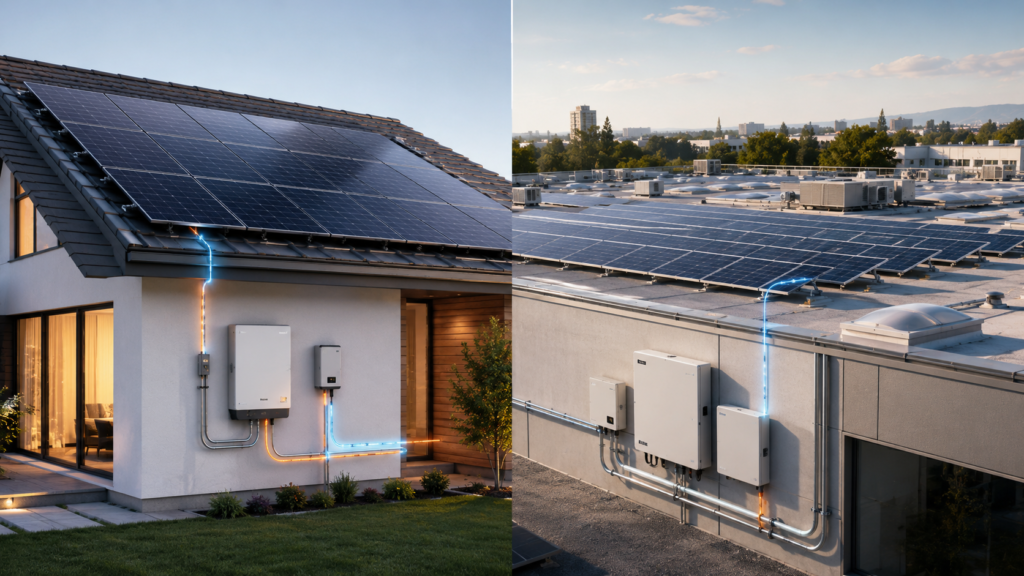
A solar battery can be one of the most useful parts of an energy system — but only if it fits your actual needs.
Solar panels get most of the attention.
They are visible.
They sit on the roof.
They turn sunlight into electricity.
They make the energy system feel real.
But solar panels only solve one part of the energy problem.
They produce power.
A battery helps control when that power gets used.
That difference matters.
Without a battery, solar energy is mostly used while the sun is shining, or sent back to the grid depending on your utility rules.
With a battery, some of that solar energy can be stored and used later.
That can help with backup power, evening usage, time-of-use rates, demand charges, EV charging, and energy control.
But a battery is not automatically right for every home or business.
The right question is not:
“Should I get a battery?”
The better question is:
“What problem do I want the battery to solve?”
What Is Home Battery Storage?
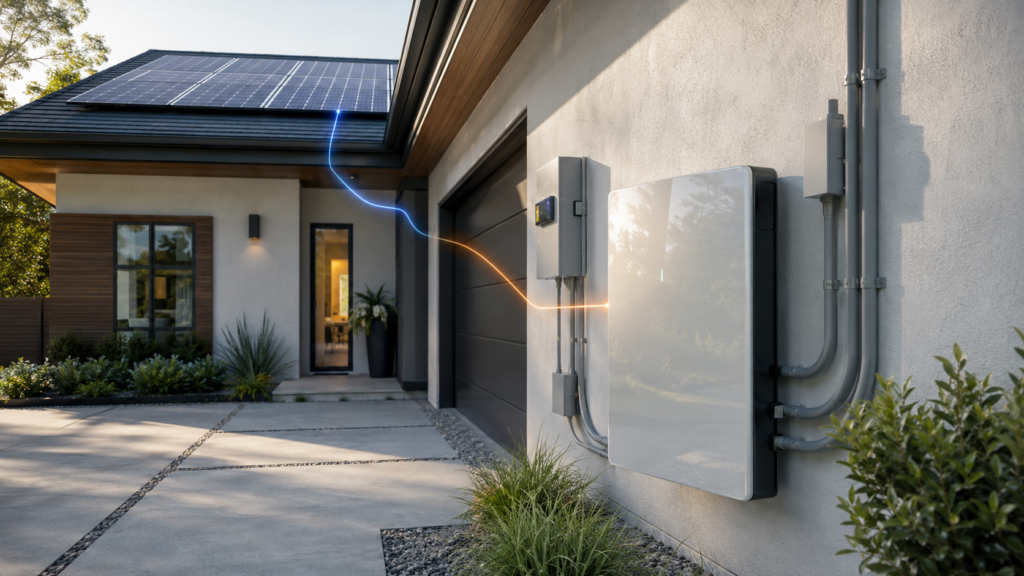
Home battery storage is a system that stores electricity for later use.
Most homeowners think of it as a backup power device, but it can do more than that.
A battery can store electricity from:
- solar panels
- the electric grid
- sometimes other energy sources, depending on system design
Then it can use that stored electricity when it makes the most sense.
That may be during an outage.
It may be during expensive evening utility hours.
It may be when solar production drops.
It may be when an EV charger needs power.
It may be when a homeowner wants more control over grid usage.
In simple terms:
Solar creates energy. A battery stores energy. Smart controls decide when to use it.
That is why battery storage is becoming more important.
Why Batteries Are Getting More Attention
Battery storage is becoming more popular because the energy system is changing.
Utility rates are getting more complicated.
Time-of-use pricing is becoming more common in some areas.
Grid outages are a bigger concern in certain regions.
Homeowners are adding EV chargers.
Businesses are looking at demand charges.
Solar export rules are changing in some markets.
People want more control over rising energy costs.
A battery can help with some of these problems.
But it depends on the property, the rate plan, the solar design, and the owner’s goals.
A battery should not be sold as a magic box.
It should be designed as part of a full energy plan.
What a Battery Can Actually Do
A battery can be useful in several ways.
Backup power
This is the reason many homeowners first consider a battery.
If the grid goes down, the battery may be able to power selected parts of the home.
But this depends on battery size, system design, and which loads are backed up.
A battery may power essentials like:
- refrigerator
- Wi-Fi
- lights
- outlets
- medical devices
- garage door opener
- small appliances
- some HVAC equipment, depending on design
But it may not power everything automatically.
Large loads like central air conditioning, electric heat, pool pumps, well pumps, EV chargers, and electric ovens may require special planning.
Backup power is not just about buying a battery.
It is about designing the backup system correctly.
Using more of your own solar power
Without a battery, excess solar power may go back to the grid.
Depending on your utility rules, you may or may not get full value for that exported power.
A battery can store extra solar energy and let you use it later.
That can be especially useful if your utility pays less for exported solar than it charges for electricity you buy later.
This is called increasing self-consumption.
In plain English:
Instead of sending extra solar power away, you keep more of it for yourself.
Time-of-use rate management
Some utilities charge different electricity rates at different times of day.
Power may be cheaper during off-peak hours and more expensive during peak hours.
A battery can help shift energy use.
For example:
- solar charges the battery during the day
- the battery powers the home during expensive evening hours
- the homeowner buys less power from the grid when rates are high
This can make battery storage more valuable in areas with strong time-of-use pricing.
Outage resilience
Backup power and resilience are related, but not exactly the same.
Backup power means the battery can run selected loads during an outage.
Resilience means the system is designed to keep the property functioning through uncertainty.
For homeowners, that may mean comfort and peace of mind.
For businesses, it may mean avoiding downtime, protecting equipment, or keeping critical systems running.
The more important reliability is, the more carefully the battery system needs to be designed.
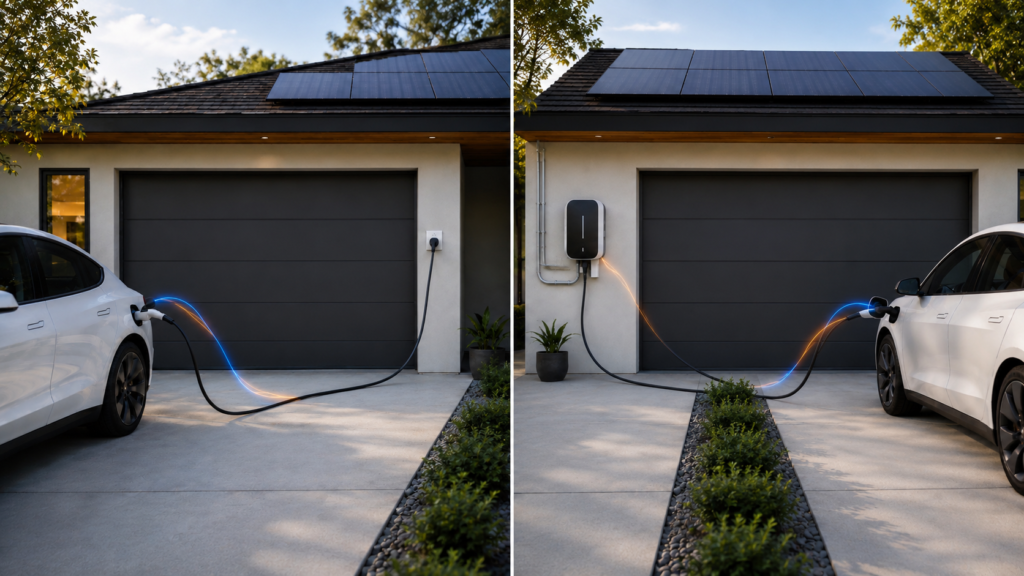
EV charging support
A battery can sometimes help support EV charging, but this needs careful planning.
An EV uses a lot of electricity.
Charging a car directly from a home battery can drain the battery quickly.
That does not mean batteries and EVs do not work together.
It means the system should be designed around real usage.
The questions are:
How often do you charge?
When do you charge?
How much do you drive?
Do you want solar to support charging?
Do you want backup power for the home or charging support for the car?
Those are different goals.
What a Battery Cannot Do
This part is important.
A battery cannot solve every energy problem.
It may not power your whole home
Many homeowners assume a battery will run the entire house exactly like the grid.
That is not always true.
A battery can be designed for whole-home backup, but that usually requires more battery capacity, more equipment, and careful load management.
Many systems are designed to back up only essential loads.
That may be the smarter and more affordable choice.
It does not create energy by itself
A battery stores energy.
It does not produce energy.
If you do not have solar, the battery must be charged from the grid.
If you do have solar, the battery can be recharged during the day when the sun is available.
This is why solar + battery is often more powerful than battery alone.
Solar helps refill the battery.
The battery helps use solar energy later.
It may not save enough money by itself
Some batteries are purchased mainly for backup power.
Others are purchased for bill savings.
Those are different reasons.
If your utility rates are simple and you have strong net metering, the battery may not create major financial savings.
If your utility has expensive peak rates or weak export credits, the battery may be more valuable.
The financial case depends on your local utility rules.
It does not replace good system design
A battery cannot fix a poorly designed solar system.
It cannot fix bad roof placement.
It cannot fix unrealistic savings estimates.
It cannot fix the wrong rate plan.
It cannot fix unclear backup expectations.
It cannot fix under-sized wiring or poor load planning.
Battery storage works best when the entire system is designed correctly.
Battery Capacity: What Does It Mean?
Battery capacity is usually measured in kilowatt-hours, or kWh.
A kilowatt-hour is a measure of energy.
Your electric bill also uses kilowatt-hours.
For example, if a device uses 1 kilowatt of power for 1 hour, that equals 1 kilowatt-hour.
Battery capacity tells you how much energy the battery can store.
A larger battery can store more energy.
But bigger is not automatically better.
The right size depends on:
- your daily usage
- your solar production
- your backup goals
- which appliances you want backed up
- how long outages usually last
- your budget
- your utility rate plan
- whether you have EV charging
- whether you want essential-load or whole-home backup
Battery sizing should be based on your actual life, not a generic package.
Power Output: The Detail People Miss
Capacity tells you how much energy the battery stores.
Power output tells you how much electricity the battery can deliver at one time.
This matters because some appliances need a lot of power to start or run.
A battery may have enough stored energy, but not enough power output to run certain large loads at the same time.
Examples of high-power loads may include:
- central air conditioning
- electric heating
- electric dryers
- electric ovens
- pool pumps
- well pumps
- EV chargers
- large commercial equipment
This is one of the most important battery design details.
A good installer should explain what the battery can power, what it cannot power, and what happens if too many large loads run at once.
Essential Loads vs. Whole-Home Backup
One of the biggest battery decisions is whether to back up essential loads or the whole home.
Essential-load backup
This means the battery powers only selected circuits during an outage.
These may include:
- refrigerator
- lights
- Wi-Fi
- selected outlets
- medical devices
- garage door opener
- small appliances
- limited HVAC or fans
This is often more affordable and more practical.
It focuses battery power on what matters most.
Whole-home backup
This means the battery system is designed to support the entire home, or most of it.
This may require:
- more battery capacity
- higher power output
- load management
- smart panels
- additional electrical work
- careful HVAC planning
- higher cost
Whole-home backup can be valuable, but it needs realistic expectations.
It does not mean unlimited power forever.
It means the system is designed to support more of the home for a certain amount of time.
AC-Coupled vs. DC-Coupled Batteries
Battery systems can be designed in different ways.
Two common terms are AC-coupled and DC-coupled.
You do not need to become an engineer, but the difference matters.
AC-coupled batteries
An AC-coupled battery connects on the AC side of the system.
This type can be easier to add to an existing solar system.
It is often used when homeowners already have solar and want to add storage later.
DC-coupled batteries
A DC-coupled battery connects more directly to the solar system before electricity is converted to AC.
This may be more efficient in some designs and can be attractive for new solar + storage installations.
The best choice depends on the solar design, inverter setup, backup needs, and whether the battery is being added now or later.
Compatibility Matters
Not every battery works with every solar system.
Battery compatibility depends on:
- inverter type
- solar system design
- electrical panel
- backup configuration
- monitoring platform
- utility requirements
- local codes
- installer experience
- future expansion plans
This is why batteries should not be treated like a simple add-on.
A battery is part of the system architecture.
Before buying, ask whether the battery works smoothly with your panels, inverter, monitoring app, and backup goals.
Battery Warranty and Lifespan
Battery warranties matter.
A battery will lose some capacity over time.
That is normal.
When comparing batteries, look at:
- warranty length
- guaranteed remaining capacity
- cycle limits
- power output warranty
- workmanship warranty
- installer warranty
- replacement process
- service support
Do not only compare brand names.
Compare what the warranty actually promises.
Also ask who handles service if there is a problem.
A strong battery with weak support can become frustrating.
Safety and Installation Quality
Battery storage is powerful equipment.
It should be installed correctly.
Important safety factors include:
- approved equipment
- proper permitting
- correct location
- electrical code compliance
- fire code compliance
- ventilation requirements
- weather protection
- safe clearances
- professional installation
- utility approval
- emergency shutoff requirements
Battery safety is not something to guess.
A battery should be installed by a qualified team that understands the equipment, local codes, and utility requirements.
What Homeowners Should Ask Before Buying
Before buying a home battery, ask:
What problem am I solving — backup, savings, or both?
Which circuits will be backed up?
Can it run my air conditioner?
How long can it power essential loads?
Will solar recharge it during an outage?
How does it work with my utility rate plan?
Will it help with time-of-use pricing?
Can I add more battery capacity later?
Is it compatible with my inverter?
What does the warranty actually cover?
Who services the system if something goes wrong?
What will the battery not power?
That last question is one of the most important.
A good installer should be honest about limits.
What Businesses Should Know
Battery storage is not just for homes.
Businesses may use batteries for different reasons.
For commercial properties, batteries may help with:
- demand charge management
- backup power
- peak shaving
- EV charging support
- solar self-consumption
- resilience
- microgrid planning
- energy cost control
- critical load support
A business should not evaluate a battery only by asking whether it can provide backup.
The better question is:
Can battery storage improve the way this property manages energy costs, timing, and risk?
That depends on the utility bill, demand charges, operating schedule, equipment loads, and future growth plans.
When a Battery Makes the Most Sense
A battery may make strong sense if:
- your utility has time-of-use rates
- your export credits are low
- outages are a concern
- you want backup power
- you have or plan to add an EV
- you want to use more of your own solar
- your business has demand charges
- your property has critical loads
- you want more energy control
- you are planning for long-term resilience
A battery may be less urgent if:
- your utility rates are simple
- your net metering is very favorable
- outages are rare
- you do not need backup power
- your budget is focused only on fastest payback
- your usage is very low
- your solar-only system already solves the main problem
That does not mean batteries are good or bad.
It means they should be evaluated honestly.
The Mistake to Avoid
The biggest mistake is buying a battery without knowing what it is supposed to do.
Some people buy one expecting whole-home backup and later discover only a few circuits are backed up.
Others buy one expecting huge savings, but their utility rate structure does not support that.
Others add EV charging and realize the battery was not sized for that kind of load.
A battery should not be sold with vague promises.
It should be explained clearly.
What it powers.
How long it lasts.
How it charges.
How it saves money.
What it cannot do.
How it fits the full energy system.
That is the difference between buying equipment and making a smart energy decision.
Sabio Takeaway
Home battery storage can be a powerful part of a solar energy system.
But it needs to match the property, the utility rate, the backup goals, and the owner’s real energy needs.
Solar produces power.
A battery stores power.
Smart design decides how that power helps you.
For some homeowners, a battery is about backup.
For others, it is about time-of-use rates.
For businesses, it may be about demand charges, resilience, or EV charging.
The right battery is not always the biggest battery.
It is the battery designed around the right problem.
That is smarter energy.
Want help understanding whether battery storage makes sense for your home or business?
Sabio can help you compare solar, battery options, EV charging, backup needs, and long-term energy goals clearly.
Explore Solar + Storage
Get a Free Energy Estimate