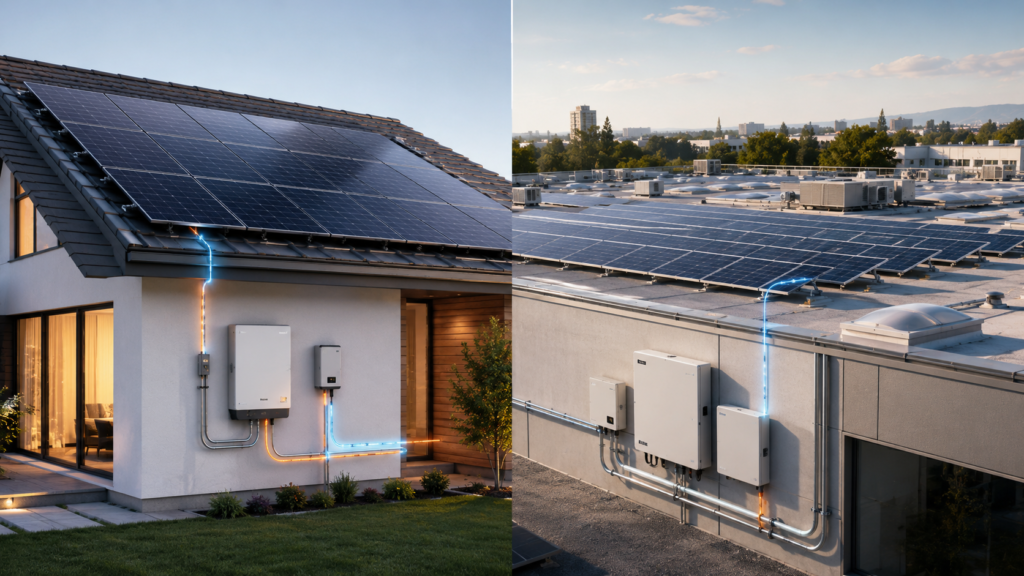
The panels get most of the attention, but the inverter is one of the most important parts of a solar system.
When most people think about solar, they picture panels on a roof.
That makes sense.
Solar panels are visible.
They collect sunlight.
They make the system feel real.
But panels are only part of the story.
Every solar system also needs an inverter.
The inverter is the equipment that turns the electricity from your solar panels into electricity your home or business can actually use.
Without an inverter, solar panels do not power your property in a useful way.
That is why choosing the right inverter setup matters.
Two of the most common options are string inverters and microinverters.
Both can work well.
But they work differently.
And the best choice depends on your roof, shade, budget, system design, monitoring needs, and long-term energy goals.
What Is a Solar Inverter?
Solar panels produce electricity in a form called direct current, or DC power.
Homes and businesses use alternating current, or AC power.
The inverter converts DC electricity from the panels into AC electricity that can be used by lights, appliances, HVAC systems, outlets, equipment, and other electrical loads.
A simple way to think about it:
Solar panels collect the energy. The inverter makes that energy usable.
That is why the inverter is sometimes called the brain or translator of the solar system.
It affects performance, monitoring, design flexibility, maintenance, safety features, and how the system handles shade or panel mismatch.
What Is a String Inverter?
A string inverter is a centralized inverter.
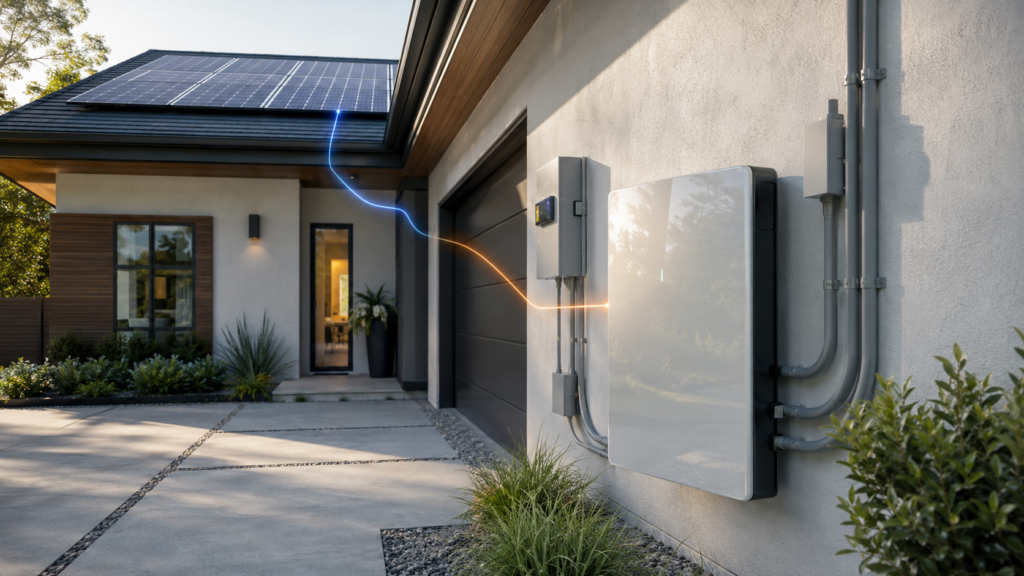
In this setup, multiple solar panels are connected together in a “string.” That string sends DC electricity to one main inverter, usually mounted on a wall, garage, exterior wall, utility area, or mechanical space.
The inverter then converts the electricity from DC to AC.
This is one of the older and more common solar inverter designs.
It is often used for:
- simple roof layouts
- large open roof areas
- commercial solar systems
- ground-mounted solar systems
- projects with minimal shading
- systems where cost efficiency matters
String inverters can be reliable and cost-effective when the design is straightforward.
But they can be less flexible when panels face different directions, receive uneven sunlight, or deal with shade.
What Is a Microinverter?
A microinverter is a small inverter installed under or near each solar panel.
Instead of one central inverter handling many panels, each panel gets its own inverter.
That means each panel converts DC power to AC power individually.
This setup is common in residential solar and is often used when roofs are more complex.
Microinverters can be helpful for:
- roofs with shading
- panels facing different directions
- multiple roof planes
- homes with chimneys, trees, vents, or dormers
- homeowners who want panel-level monitoring
- systems where design flexibility matters
The main idea is simple:
With microinverters, each panel works more independently.
That can help when one panel is shaded or underperforming.
The Biggest Difference
The biggest difference between string inverters and microinverters is how they handle panel performance.
With a traditional string inverter setup, panels are connected together in a group.
If one panel in the string performs worse because of shade, dirt, angle, or mismatch, it can affect the performance of the whole string.
With microinverters, each panel operates more independently.
If one panel is shaded, the others can keep producing more normally.
That does not mean microinverters magically eliminate shade problems.
Shade is still shade.
But microinverters can reduce the impact of one weaker panel dragging down a larger group.
String Inverter Pros
String inverters can be a strong option when the system is simple and well-designed.
Lower upfront cost
String inverter systems are often less expensive than microinverter systems because there are fewer inverter units.
That can make them attractive for larger systems or projects where cost control matters.
Easier access to main equipment
Because the main inverter is usually mounted in an accessible location, service may be simpler in some cases.
Instead of accessing equipment under individual panels, the main inverter can often be inspected at ground level or in a utility area.
Strong for simple roof layouts
If the roof has one main sunny area with panels facing the same direction and little shade, a string inverter can work very well.
Common in commercial systems
Commercial solar systems often use string inverters because the roof areas may be large, open, and easier to design in clean sections.
String Inverter Cons
String inverters are not always the best fit.
Shade can affect more panels
If one panel in a string is shaded or underperforming, it may reduce the performance of the group.
This can matter if the roof has trees, chimneys, vents, nearby buildings, or uneven sunlight.
Less panel-level control
Traditional string inverter systems usually provide less detailed panel-level performance information unless paired with optimizers or advanced monitoring.
Less flexible for complex roofs
If panels need to face different directions or be split across many roof planes, string inverter design can become more complicated.
Central point of failure
Because one inverter handles a large part of the system, if that inverter has an issue, a larger portion of the solar system may stop producing until it is fixed.
Microinverter Pros
Microinverters can be a strong option for many homes and some smaller commercial systems.
Better for shade and mixed roof angles
Because each panel operates more independently, microinverters can work well when panels face different directions or experience partial shading.
Panel-level monitoring
Microinverter systems often allow homeowners or installers to see how each panel is performing.
That can make it easier to spot issues.
Flexible design
Microinverters make it easier to design systems across multiple roof planes.
This is helpful for homes with complicated roof shapes.
No single central inverter for the whole system
If one microinverter has an issue, it usually affects one panel, not the entire system.
The rest of the system can often continue producing.
Microinverter Cons
Microinverters are not perfect.
Higher upfront cost
Microinverter systems usually cost more than basic string inverter systems because there is more equipment.
More components on the roof
Because each panel has its own inverter, there are more electronic components installed on the roof.
That can make maintenance more complicated if a unit needs replacement.
Roof access may be needed for service
If a microinverter fails, someone may need to access the roof and remove or lift a panel to service it.
May not be necessary for simple systems
If the roof is wide open, sunny, and simple, microinverters may not provide enough extra value to justify the added cost.
What About Power Optimizers?
There is also a middle option that often comes up: power optimizers.
A power optimizer is installed at each panel, but it does not convert DC to AC at the panel the way a microinverter does.
Instead, optimizers manage the DC output from each panel and send it to a central inverter.
So the system still has a main inverter, but each panel gets more individual control than a basic string setup.
This can be useful when you want some panel-level performance benefits but still use a central inverter.
In simple terms:
String inverter: many panels feed one inverter.
Microinverter: each panel has its own inverter.
Optimizer system: each panel has control electronics, but the main inverter still does the DC-to-AC conversion.
Optimizers can be a good fit for systems with moderate shade, mixed roof angles, or monitoring needs.
Which Setup Is Better for Homeowners?
For many homeowners, microinverters are attractive because residential roofs are often complicated.
A typical home may have:
- multiple roof planes
- trees nearby
- chimneys
- vents
- skylights
- different panel angles
- morning shade
- afternoon shade
- limited roof space
- aesthetic concerns
In these situations, microinverters can offer more flexibility and better panel-level visibility.
But they are not automatically the best choice for every home.
A simple roof with strong sun exposure and one clean panel layout may perform very well with a string inverter or optimizer-based design.
The right choice depends on the actual roof.
Not the sales pitch.
Which Setup Is Better for Businesses?
For businesses, the answer depends heavily on the property.
A large flat commercial roof may be a strong fit for string inverters because the system can be designed in clean sections.
This can help reduce cost and simplify larger projects.
String inverters are often common for:
- warehouses
- distribution centers
- manufacturing facilities
- large office buildings
- retail centers
- schools
- commercial rooftops
- ground-mounted systems
But some commercial buildings may benefit from optimizers or microinverters if there are:
- multiple roof sections
- shade from rooftop equipment
- different roof angles
- complex electrical design needs
- detailed monitoring requirements
- safety or code considerations
- smaller commercial roof areas
Commercial solar is more about engineering than trend-following.
The best inverter choice should match the building, usage, system size, budget, and maintenance plan.
How Shade Changes the Decision
Shade is one of the biggest factors in inverter selection.
Shade can come from:
- trees
- chimneys
- neighboring buildings
- rooftop HVAC equipment
- vents
- parapet walls
- utility poles
- seasonal sun angle changes
- debris or dirt buildup
If the roof has little or no shade, a string inverter may work well.
If the roof has partial shade at different times of day, microinverters or optimizers may make more sense.
But here is the important point:
The best solution is not just choosing better electronics. The best solution is designing the system correctly from the beginning.
Sometimes the smartest move is to avoid putting panels in poor solar areas at all.
More panels are not always better if some of them produce poorly.
Monitoring Matters More Than People Think
Monitoring is another major difference.
A basic solar monitoring system may show total system production.
That tells you how much the system is producing overall.
Panel-level monitoring can show how each panel is performing.
That can be useful if:
- one panel is underperforming
- a microinverter has an issue
- shading patterns change
- dirt or debris affects one section
- system performance needs to be diagnosed
- the owner wants more visibility
For homeowners, panel-level monitoring can provide peace of mind.
For businesses, monitoring can help with maintenance, reporting, and long-term performance tracking.
But monitoring is only useful if someone actually pays attention to it.
Data should lead to better decisions, not just another app on your phone.
Reliability and Maintenance
Both string inverters and microinverters can be reliable when properly designed and installed.
The maintenance question is different.
With a string inverter, there are fewer inverter units, and the main equipment may be easier to access.
But if the central inverter fails, it may affect a larger part of the system.
With microinverters, one failure may only affect one panel.
But the equipment is usually located on the roof, which can make service more involved.
That is why warranty, installer quality, equipment selection, and service support matter.
The best system is not just the one with the best spec sheet.
It is the one that can perform well and be supported over time.
Cost vs. Value
This decision should not be made on cost alone.
A cheaper system is not always a better system.
An expensive system is not automatically smarter either.
The better question is:
What value does this inverter setup add for this specific property?
Microinverters may be worth it if they solve real design challenges.
String inverters may be better if the system is simple and cost efficiency matters.
Optimizers may make sense when you want panel-level control with a central inverter approach.
The goal is not to buy the most complicated system.
The goal is to buy the right system.
What to Ask Before Choosing
Before deciding between string inverters, microinverters, or optimizers, ask these questions:
Does my roof have shade?
Do my panels face different directions?
Is my roof simple or complex?
Will I want panel-level monitoring?
How easy will the system be to service?
What happens if one inverter fails?
What warranty comes with the equipment?
How does the system handle future expansion?
Will I add batteries later?
Will I add EV charging later?
Is this setup designed for my actual usage and property, or is it just the installer’s default package?
Those questions will tell you more than a sales brochure.
The Mistake to Avoid
The biggest mistake is letting someone reduce the decision to one simple answer.
You may hear:
“Microinverters are always better.”
Or:
“String inverters are cheaper, so they are better.”
Or:
“This brand is the only one you should use.”
That is not how good solar design works.
The right answer depends on the property.
A shaded home roof and a large flat warehouse roof do not need the same inverter strategy.
A homeowner focused on backup power and monitoring may care about different things than a business focused on project size and payback.
Good solar design starts with the site.
Then the equipment decision follows.
Sabio Takeaway
String inverters and microinverters can both be good options.
The right choice depends on your roof, shade, system size, budget, monitoring needs, and long-term energy goals.
A string inverter may make sense for a simple, sunny roof or a large commercial project.
Microinverters may make sense for homes with shade, multiple roof angles, or owners who want panel-level monitoring.
Optimizers may be a useful middle ground in some designs.
The smartest solar system is not the one with the most buzzwords.
It is the one designed around your actual property.
That is smarter energy.
Want help understanding which solar technology makes sense for your home or business?
Sabio can help you compare system designs, inverter options, batteries, EV charging, and long-term energy goals clearly.
Explore Solar Technology
Get a Free Energy Estimate