
Solar doesn’t start with panels. It starts with one number:
👉 how much energy you use.
Because that number determines everything — cost, savings, and your long-term independence.
Let’s make it simple.
⚡ Step 1: Find Your Real Usage (kWh, Not Dollars)
Your bill shows dollars.
Ignore that for a second.
What matters is: 👉 kWh (kilowatt-hours)
Look at your last 12 months.
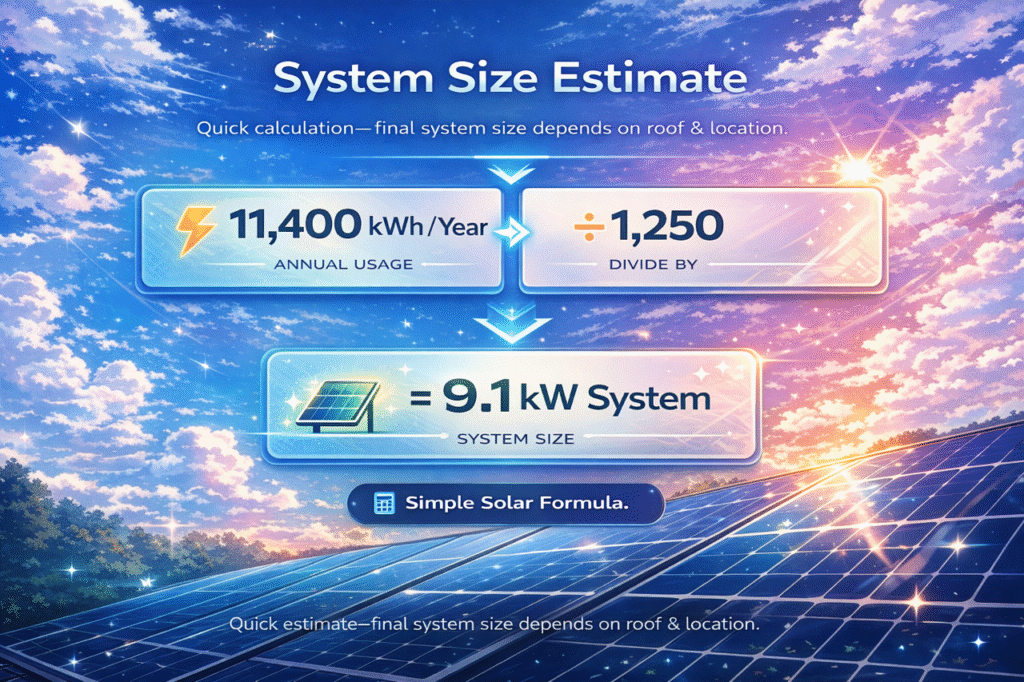
Example: 11,400 kWh/year
☀️ Step 2: Use the Updated 2026 Formula
⭐ System Size (kW) = Annual kWh ÷ 1,250
Why slightly higher than before?
Because modern systems account for:
• smarter inverters
• better panel efficiency
• regional production differences
Example:
11,400 ÷ 1,250 =
👉 ~9.1 kW system
🧠 What Changed in 2026
Solar systems are:
- slightly more efficient
- better optimized with software
- increasingly paired with batteries
👉 Meaning: fewer panels, smarter output.
🏠 Step 3: Future-Proof Your System
In 2026, this matters more than ever.
Ask yourself:
- EV coming soon?
- Heat pump / electrification?
- Work-from-home permanently?
👉 Oversizing by 10–20% is now standard.
Because your energy use is going up, not down.
🌤 Step 4: Your Roof Still Matters
Two identical homes can need different systems.
Key variables:
- Direction (south > east/west > north)
- Shade
- Roof condition
👉 This is where software (Aurora / Helioscope) finalizes your design.
🔋 Step 5: Batteries Are No Longer Optional (2026 Reality)
In many states (especially CA, TX):
👉 Solar without storage = leaving money on the table
Why:
- peak pricing is more aggressive
- net metering payouts are lower
- grid instability is increasing
🧠 Sabio Summary
Solar sizing is no longer guesswork.
👉 It’s your usage + your future + smarter systems.