A sunrise can be more than a scene.
Sometimes, light changes everything.
A harbor becomes color.
A morning becomes mood.
A few brushstrokes become a movement.
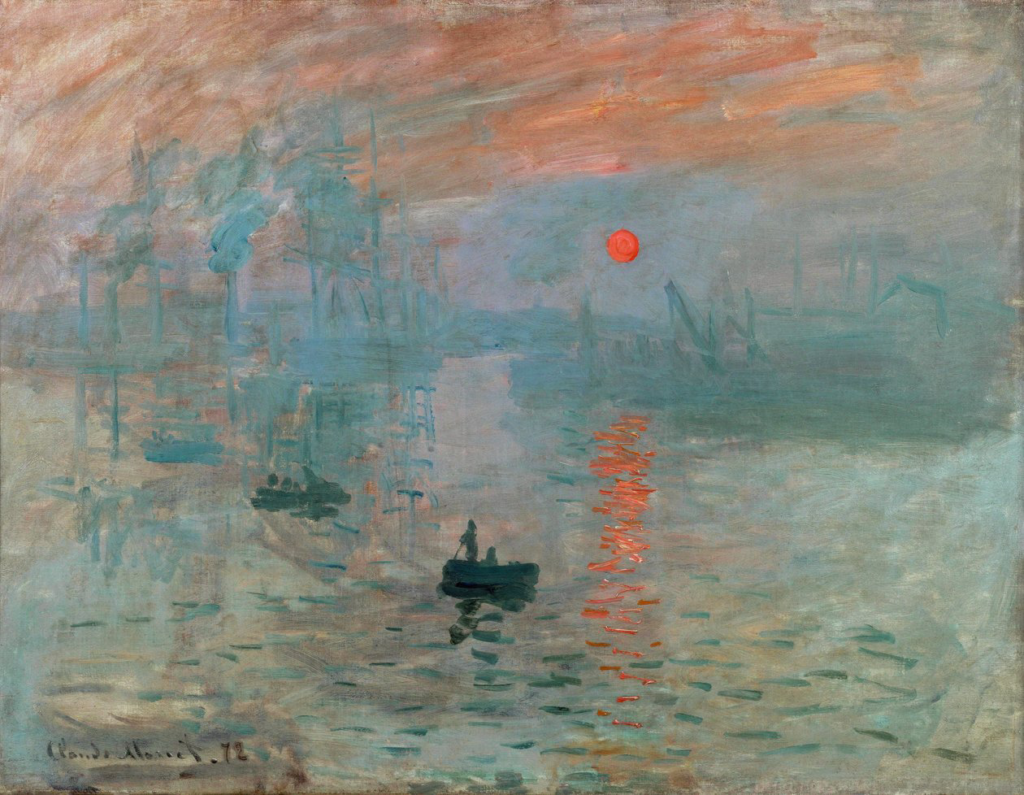
Claude Monet’s Impression, Sunrise is one of those rare paintings that feels quiet at first, then begins to grow in importance the longer you sit with it.
It is not dramatic in the obvious way.
There is no grand mythology.
No heroic figure.
No perfect architectural view.
Just a hazy harbor, soft water, dark boats, smoke, mist, and a small orange sun rising over Le Havre.
But that was enough.
That simple sunrise helped give Impressionism its name and changed the way people thought about painting, light, and the act of seeing.
⸻
The Harbor at Le Havre
Monet painted Impression, Sunrise after a stay in Le Havre, the French port city where he had spent part of his youth. The Musée Marmottan Monet notes that a stay at the Hôtel de l’Amirauté around November 1872 gave Monet the subject for what would become his most famous painting.
The scene is industrial and atmospheric.
Ships sit in the distance.
Smoke rises into the sky.
Small boats drift across the water.
The morning light breaks through haze.
Monet was not trying to carefully describe every object.
He was painting an impression.
The feeling of a moment before it disappeared.
⸻
The Sun as a Pulse of Color
The sun in Impression, Sunrise is small, but it controls the painting.
It is just a red-orange disk near the horizon, yet everything seems to move around it.
The water picks up its reflection.
The mist makes it glow.
The boats become silhouettes.
The harbor becomes atmosphere.
The Museum Barberini describes the red disk of the rising sun as the focus of the composition, which is exactly what makes the painting so powerful.
Monet does not make the sun large.
He makes it essential.
It becomes the emotional center of the scene.
A signal.
A pulse.
A beginning.
⸻
How a Critic Gave Impressionism Its Name
When Monet showed the painting in 1874, it became part of a larger turning point in art.
That year, a group of artists organized an independent exhibition in Paris outside the official Salon system. The Metropolitan Museum of Art notes that this 1874 exhibition helped launch what became known as Impressionism.
The word “Impressionism” was not originally a compliment.
Critic Louis Leroy used the title Impression, Sunrise to mock the loose, unfinished quality of the work. The National Gallery of Art explains that the term “Impressionist” came from a derisive review of Monet’s painting.
But the name stayed.
What was meant as criticism became a movement.
That is one of the beautiful ironies of art history.
A painting accused of being unfinished helped open the door to a new way of seeing.
⸻
Why It Felt So Different
Before Impressionism, much of academic painting valued polish, detail, and historical seriousness.
Monet and his peers were interested in something else.
Changing light.
Modern life.
Outdoor atmosphere.
The feeling of a specific hour.
Color as experience.
Impression, Sunrise does not ask us to admire technical perfection in the old way.
It asks us to notice perception.
How does morning light feel?
How does fog change distance?
How does color move across water?
How much detail do we really need before a scene becomes alive?
That question still feels modern.
Because most of life is not experienced as perfect detail.
It arrives as light, movement, mood, and memory.
⸻
Sunlight as Perception
Monet’s sunrise is not just a subject.
It is a way of seeing.
The painting reminds us that light does not simply reveal the world. It changes the world.
A street in morning light is not the same street at noon.
A room at sunset is not the same room at night.
A roof, a garden, a window, a harbor, a face — all of them change as light changes.
That is why Monet fits so well inside Inspired by the Sun.
He helps us understand sunlight not as decoration, but as experience.
The sun does not just sit in the sky.
It shapes perception.
⸻
From Monet’s Sunrise to Solar Thinking
Solar energy is often discussed through practical numbers.
Kilowatt-hours.
Utility bills.
Panel output.
Battery storage.
Payback periods.
Those things matter.
But Impression, Sunrise reminds us that sunlight has always been more than data.
It is atmosphere.
It is rhythm.
It is color.
It is time.
It is the quiet beginning of a day.
Solar technology gives us a modern way to work with sunlight.
Art gives us a timeless way to feel it.
Both begin with attention.
⸻
Why This Belongs in Inspired by the Sun
This series is about the creative side of energy.
Not just panels.
Not just savings.
Not just technology.
But the deeper relationship between sunlight and human imagination.
Monet’s Impression, Sunrise belongs here because it shows how a simple sunrise can shift culture.
One small orange sun.
One misty harbor.
One fleeting moment.
And suddenly, painting had a new name.
⸻
Sabio Takeaway
Monet helped people see sunlight differently.
Not as a fixed object, but as something alive, changing, and emotional.
Impression, Sunrise reminds us that light can transform ordinary places into something unforgettable.
That is why it still feels fresh.
And why it belongs in a series about the sun, creativity, and the energy that shapes our world.