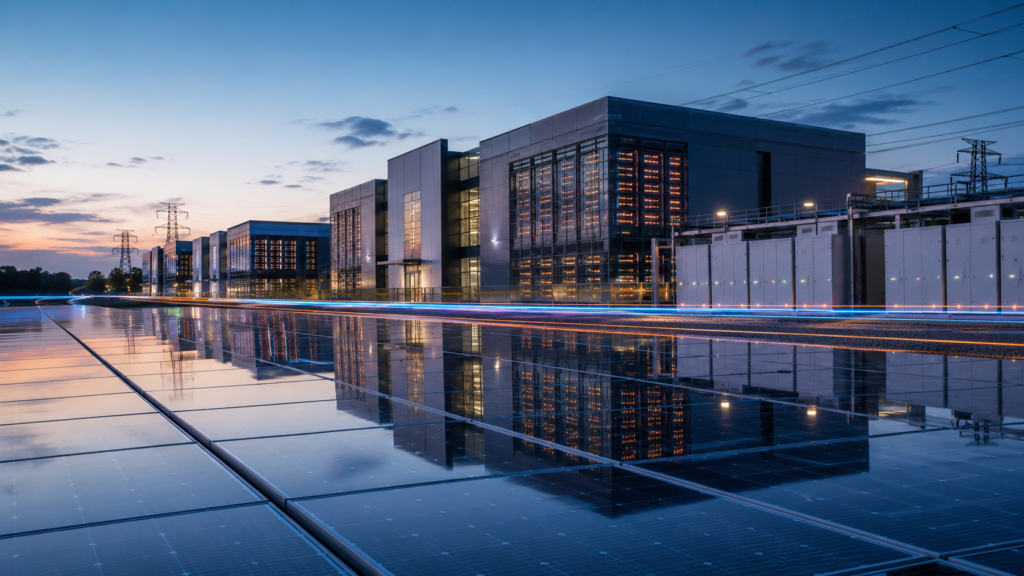
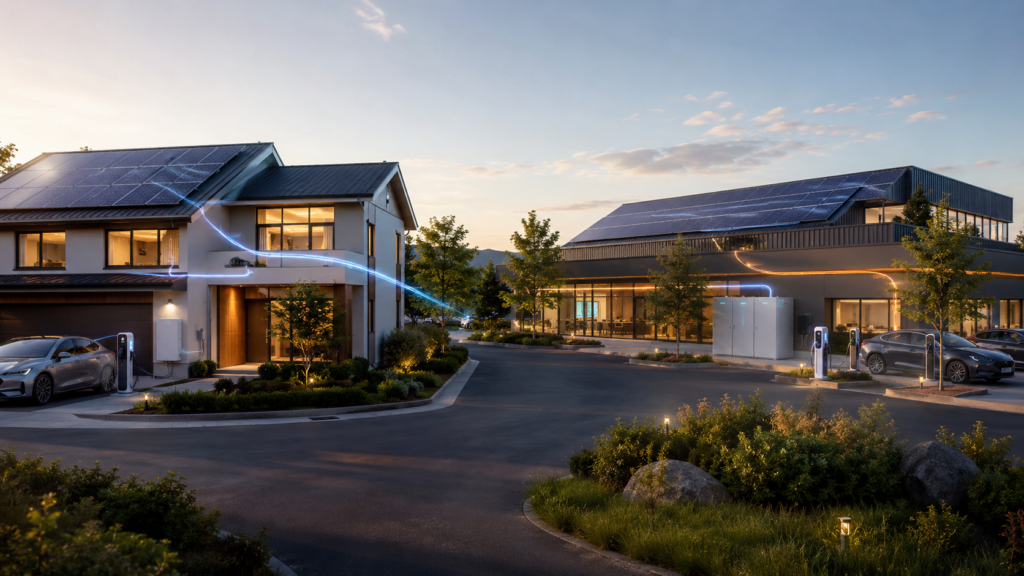
The future of energy is not one product. It is a connected system.
Solar used to be the main conversation.
A homeowner asked:
“Should I put solar panels on my roof?”
A business asked:
“Can solar lower our electric bill?”
That conversation still matters.
But energy is changing.
Today, solar is becoming part of a bigger system.
Batteries are changing when solar power can be used.
EV chargers are adding new electricity demand.
Smart panels and monitoring apps are helping people understand usage.
Businesses are paying closer attention to demand charges.
Utilities are changing rate structures.
Data centers and electrification are putting more pressure on the grid.
The future is not just solar.
It is solar + storage + charging + smart control.
That matters because energy decisions are starting to connect.
A solar system affects battery value.
A battery affects EV charging strategy.
EV charging affects utility bills.
Utility rates affect system design.
Smart monitoring affects how well everything works together.
The next generation of energy is not one device.
It is a smarter network.
What Is Happening
Electricity is becoming more important across the economy.
The International Energy Agency says the “Age of Electricity” will require faster grid expansion and more system flexibility as solar, wind, batteries, EVs, heat pumps, and data centers all grow. The IEA projects that solar PV and wind could rise from about 17% of global electricity generation today to 27% by 2030, while newer sources of demand like EVs, heat pumps, and data centers grow quickly.
At the same time, the U.S. is adding large amounts of solar and storage. The U.S. Energy Information Administration said developers planned to add 43.4 GW of new utility-scale solar capacity in 2026, a 60% increase from the previous year if realized. More than half of that planned solar capacity was concentrated in Texas, Arizona, California, and Michigan.
Battery storage is also growing quickly. SEIA reported that the U.S. installed 9.7 GWh of energy storage capacity in Q1 2026, the strongest first quarter in the sector’s history and up 32% year over year.
This is the bigger shift:
We are not just adding more energy devices. We are connecting them into smarter energy systems.
Why Solar Alone Is No Longer the Whole Story
Solar is still the foundation.
It turns sunlight into electricity.
It can lower grid purchases.
It can reduce exposure to rising utility rates.
It can make roofs, land, and parking canopies more productive.
But solar has one important limitation:
It produces power when the sun is shining.
That does not always match when a home or business needs power most.
A homeowner may use more electricity in the evening.
A business may hit expensive demand peaks at certain times.
A hotel may need power around the clock.
A warehouse may charge vehicles overnight.
A retail center may need EV chargers during busy shopping hours.
A data center may need constant power.
That is why the conversation has expanded.
Solar answers one question:
How can we produce more of our own power?
Batteries answer the next question:
How can we control when we use that power?
Batteries Are the Bridge
Battery storage is becoming the bridge between solar production and real-world energy needs.
A battery can store solar energy and use it later.
That can help with:
- evening usage
- backup power
- peak demand
- demand charges
- time-of-use rates
- EV charging
- resilience
- grid support
For homeowners, a battery may help keep essential loads running during an outage or reduce dependence on expensive evening utility rates.
For businesses, a battery may help reduce demand spikes or support backup planning.
For larger facilities, batteries may become part of microgrids, EV charging infrastructure, or grid services.
The important point is simple:
Solar produces. Batteries manage.
That combination is becoming more valuable as utility rates become more complex.
EV Charging Changes the Math
EV charging is one of the biggest reasons energy planning is becoming more connected.
An EV is not just a vehicle.
It is also a new electrical load.
For a homeowner, one EV can change the home’s energy profile.
For a business, multiple chargers can create new peak demand.
For a hotel, EV charging can become a guest amenity.
For a retail center, chargers may attract customers but also increase electricity demand.
For a warehouse or fleet depot, charging multiple vehicles can become a major operational energy issue.
The IEA’s Global EV Outlook 2026 says that as EV deployment and charging speeds increase, grid capacity constraints could become more pronounced in some regions. It also says electricity demand from EVs could exceed 1,500 TWh by 2035 under current policies, roughly six times 2025 levels.
That means EV charging cannot be treated as an afterthought.
It should be planned alongside solar, batteries, utility rates, electrical capacity, and future growth.
Smart Monitoring Makes the System Usable
A connected energy system needs visibility.
That is where monitoring apps, smart panels, and energy management tools become important.
Without monitoring, many people only see the bill after the fact.
With better monitoring, homeowners and businesses can understand:
- when they use the most power
- when solar produces the most energy
- when battery power is being used
- when EV charging happens
- when demand peaks occur
- when utility rates are highest
- where energy may be wasted
This matters because better data leads to better decisions.
A homeowner may learn that evening usage is driving costs.
A business may discover that one equipment startup creates a demand spike.
A hotel may see that EV charging overlaps with HVAC peaks.
A warehouse may realize that charging schedules need to be managed.
The future of energy is not just about installing equipment.
It is about understanding how the equipment works together.
What This Means for Homeowners
For homeowners, the connected energy system may look like this:
- rooftop solar
- home battery
- EV charger
- smart thermostat
- energy monitoring app
- utility rate plan
- backup load panel
The goal is not to make the home complicated.
The goal is to make the home smarter.
A connected system can help homeowners:
- reduce grid purchases
- use more solar power at home
- charge an EV more strategically
- prepare for outages
- manage time-of-use rates
- understand energy habits
- feel more control over the electric bill
This is where the emotional value matters.
People do not just want technology.
They want the feeling that their home is ready for the future.
What This Means for Businesses
For businesses, the connected system can be more powerful.
A commercial property may combine:
- rooftop solar
- solar parking canopies
- battery storage
- EV chargers
- building energy management
- demand charge management
- backup systems
- monitoring software
- microgrid controls
That can help businesses think more strategically about energy.
A retail center may use solar canopies and EV chargers to improve customer experience.
A warehouse may use solar and storage to support logistics and fleet charging.
A hotel may use solar, storage, and EV charging to support guest comfort and property appeal.
A manufacturing facility may use solar and batteries to control costs and reduce demand spikes.
A data center may use solar as one piece of a larger energy strategy.
For businesses, energy is becoming less of a background expense.
It is becoming part of operations, branding, resilience, and long-term planning.
Why This Matters for the Grid
The grid is also changing.
As more solar, batteries, EVs, and smart devices connect, the grid becomes more dynamic.
That can create challenges.
But it can also create opportunity.
A connected energy system can help reduce stress when it is designed correctly.
For example:
- batteries can reduce peak demand
- EV charging can be scheduled during better hours
- solar can reduce daytime grid purchases
- smart controls can shift loads
- commercial systems can participate in demand response
- microgrids can support critical facilities
The IEA notes that the electric system needs more flexibility to integrate changing generation, demand, and storage.
That is the key word:
flexibility.
The future grid will need more of it.
The Mistake to Avoid
The biggest mistake is treating every energy upgrade separately.
A homeowner installs solar without thinking about future EV charging.
A business adds EV chargers without thinking about demand charges.
A hotel adds batteries without understanding critical loads.
A retail center installs solar canopies without planning charger placement.
A warehouse signs a solar contract without reviewing fleet electrification.
That is how projects become more expensive than they need to be.
The smarter approach is to ask:
What will this property need over the next 5 to 10 years?
That question changes the design.
The Emotional Side of Connected Energy
Connected energy sounds technical.
But the real emotion is simple:
People want to stop reacting.
Homeowners do not want to be surprised by rising bills.
Businesses do not want energy costs eating into margins.
Property owners do not want buildings to feel outdated.
Hotels do not want guest comfort tied to unstable energy planning.
Warehouses do not want EV charging to create demand problems.
Manufacturers do not want production exposed to energy spikes.
A connected energy system gives people a way to plan ahead.
That is the real value.
Not just technology.
Confidence.
What to Watch Next
Sabio will be watching:
- battery storage adoption
- EV charger growth
- smart panel development
- solar + storage incentives
- utility time-of-use rates
- demand charge changes
- virtual power plant programs
- home energy management systems
- commercial microgrid projects
- bidirectional EV charging
- fleet electrification
- AI-driven energy management tools
The future of energy will not be one product category.
It will be an ecosystem.
The winners will be the homes, businesses, and properties that understand how the pieces work together.
Sabio Takeaway
Solar, batteries, and EV charging are becoming one connected energy system.
Solar creates power.
Batteries control timing.
EV chargers add new demand.
Smart monitoring makes the system visible.
Better planning connects everything.
The future of energy is not just cleaner.
It is smarter.
And the smartest energy decisions are the ones designed around real life — not isolated products.
That is where Sabio helps.
Want to understand how solar, battery storage, or EV charging could fit your home or business?
Ready to see what your home can generate?