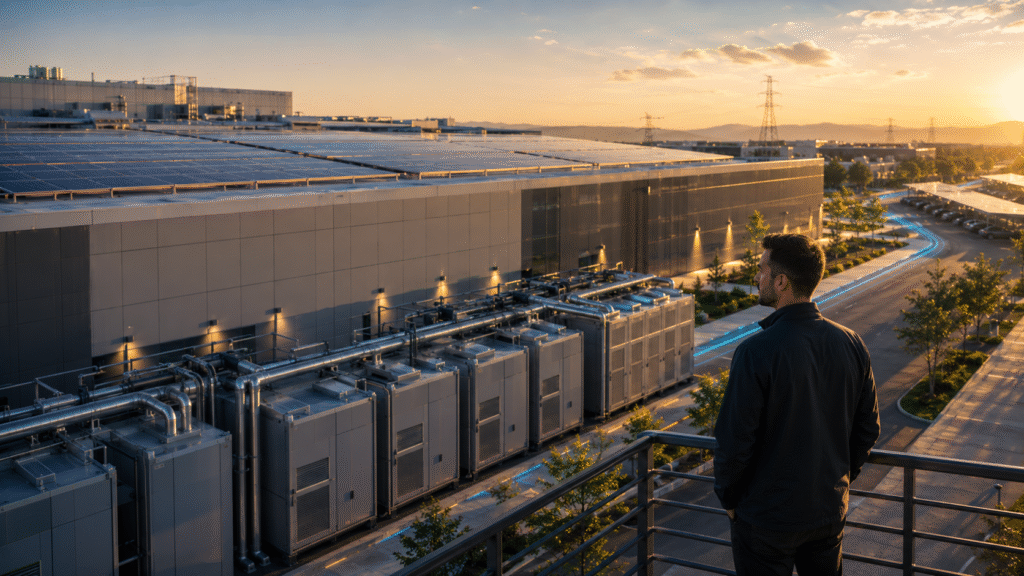

The honest answer: enough to solve your real energy problem — not enough to cover every inch of your roof.
A lot of businesses start commercial solar with the wrong question.
They ask:
“How many panels can we fit?”
That sounds logical.
But it is not the best starting point.
The better question is:
“How much solar does our business actually need?”
Because commercial solar is not about filling a roof.
It is about designing a system around:
- your utility bill
- your operating hours
- your peak demand
- your roof or land space
- your rate structure
- your growth plans
- your storage needs
- your financial goals
A bigger system is not always a better system.
A smarter system is.
Start With the Utility Bill
For a business, your utility bill is not just a bill.
It is a map.
It shows:
- how much electricity you use
- when you use it
- what you pay per kWh
- whether demand charges apply
- whether your usage changes seasonally
- whether your business has expensive peak periods
This matters because commercial solar is not sized only by square footage.
It is sized by load.
A warehouse, restaurant, office building, grocery store, manufacturing facility, and data center can all have very different energy patterns.
Same roof size.
Very different solar strategy.
The Two Numbers That Matter Most
For commercial solar, two numbers usually matter most:
1. kWh usage
This is total energy used over time.
It answers:
“How much electricity does the business consume?”
2. kW demand
This is peak power draw at a specific moment.
It answers:
“How intense is the business’s highest power spike?”
This distinction matters.
A business may not use massive total energy over the month, but it may still get hit by demand charges if it creates sharp power spikes. NREL explains that demand charges are commonly part of commercial electric bills and are tied to peak electricity demand, not just total energy consumption.
That is why commercial solar sizing needs more than a monthly total.
It needs a load profile.
Why 12 Months of Data Matters
Do not size a commercial solar system from one bill.
One bill can lie.
Maybe the building used more HVAC during summer.
Maybe production slowed down that month.
Maybe refrigeration loads changed.
Maybe occupancy was unusual.
Maybe the business was closed for renovations.
Maybe one demand spike distorted the bill.
A better solar design reviews at least 12 months of utility bills.
Even better:
- interval data
- 15-minute demand data
- hourly usage
- seasonal load patterns
- peak demand history
- operating schedule
Commercial solar is a long-term energy decision.
It should not be designed around one weird month.
Roof Space Is Important — But It Comes Second
Your roof matters.
But it is not the beginning of the story.
The Department of Energy explains that rooftop solar potential depends on factors such as roof size, shading, direction, and location. It also notes that rooftop potential is not the same thing as economic potential because it does not account for availability or cost.
That is important.
Just because you can fit a large solar array does not mean you should.
A commercial solar design has to consider:
- usable roof area
- roof age
- structural capacity
- roof membrane condition
- equipment spacing
- fire access pathways
- shading
- HVAC units
- skylights
- drains
- parapets
- future roof work
- utility interconnection limits
The roof shows the possibility.
The utility bill shows the need.
The business case connects both.
Flat Roofs vs. Pitched Roofs
Many commercial buildings have flat roofs.
That can be useful because solar panels can often be arranged in rows using racking systems designed for angle, spacing, and maintenance access.
But flat roofs also require careful planning.
The system has to account for:
- row spacing
- wind loads
- ballast or attachments
- drainage
- roof membrane protection
- equipment access
- fire code pathways
- shading between rows
Pitched roofs have their own considerations:
- roof orientation
- roof angle
- attachment method
- panel symmetry
- maintenance access
- aesthetics
- structural condition
In either case, the question is not simply:
“Can panels fit?”
The question is:
“Can panels fit in a way that works for the building?”
Operating Hours Change the Solar Strategy
A business that uses most of its power during the day may be a strong fit for solar-only.
Examples:
- offices
- schools
- retail stores
- warehouses
- light manufacturing
- grocery stores
- daytime medical offices
A business that uses more power at night may need a different strategy.
Examples:
- cold storage
- hospitality
- data centers
- 24/7 manufacturing
- EV fleet charging
- restaurants with evening peaks
That does not mean solar will not work.
It means battery storage, load shifting, and rate design may matter more.
Solar is strongest when production lines up with usage.
When it does not, storage may help close the gap.
Demand Charges Can Change the Size
This is where commercial solar gets more serious.
If your utility bill includes demand charges, the best solar system may not be the one that produces the most energy overall.
It may be the system that helps reduce expensive peaks.
NREL research on demand charge savings from PV and storage found that demand-charge savings vary significantly depending on demand-charge design and the customer’s load profile.
In plain English:
Two businesses can install the same solar system and get very different demand-charge results.
Why?
Because their usage patterns are different.
This is why commercial solar should be designed from real data.
Not assumptions.
When Battery Storage Changes the System Size
A battery changes the sizing conversation.
Solar-only asks:
“How much energy can we produce during the day?”
Solar + battery asks:
“How much energy can we produce, store, and use strategically?”
A battery may help with:
- demand charge reduction
- peak shaving
- backup power
- load shifting
- EV charging support
- resilience
- better use of onsite solar
But battery storage also adds cost and complexity.
So the question is not:
“Should every business add a battery?”
The question is:
“Does storage solve a real financial or operational problem?”
If yes, it may be worth modeling.
If no, it may be unnecessary.
EV Charging and Future Growth Matter
Your business may not use the same amount of electricity in three years that it uses today.
Future growth matters.
Before sizing commercial solar, ask:
- Are you adding EV chargers?
- Are you electrifying a fleet?
- Are you adding refrigeration?
- Are you expanding production?
- Are you adding tenants?
- Are you extending operating hours?
- Are you adding HVAC capacity?
- Are you planning a battery system?
- Are you adding data or computing loads?
EV charging is especially important because multiple chargers can create new demand spikes.
The Department of Energy notes that smart charge management can help reduce electricity costs by avoiding demand charges or peak pricing, which is highly relevant for businesses adding fleet or workplace charging.
A good solar design should not only fit today.
It should anticipate where the business is going.
Should You Offset 100% of Usage?
Not always.
A lot of businesses assume the goal is to offset 100% of electricity usage.
Sometimes that makes sense.
Sometimes it does not.
A partial offset may be smarter if:
- roof space is limited
- utility export credits are weak
- demand charges matter more than total usage
- the business has high nighttime loads
- financing works better at a smaller size
- interconnection limits apply
- battery storage would be needed for higher offset
- the system would be oversized for real daytime use
The goal is not a perfect marketing number.
The goal is the best business case.
Sometimes that is 40%.
Sometimes 70%.
Sometimes 100%.
Sometimes solar + storage.
Sometimes solar now and storage later.
The right answer depends on the building.
Commercial Solar Sizing Inputs
A serious commercial solar proposal should consider:
Utility data
- 12 months of bills
- annual kWh usage
- peak kW demand
- rate tariff
- demand charges
- time-of-use periods
- export credit rules
Site data
- roof size
- roof age
- structural capacity
- shading
- orientation
- available land or carport space
- electrical room location
- utility interconnection point
Business data
- operating hours
- seasonal activity
- growth plans
- EV charging plans
- backup needs
- sustainability goals
- ownership timeline
- financing preference
System data
- system size
- expected annual production
- production timing
- inverter strategy
- battery sizing
- monitoring
- maintenance plan
- warranty structure
If those inputs are missing, the proposal is not complete.
The Wrong Way to Size Commercial Solar
The wrong way sounds like this:
“We can fit 400 panels on your roof.”
That may be true.
But it does not answer the business question.
The better questions are:
- How much will those panels produce?
- When will they produce it?
- How much of that power will we use onsite?
- What happens to excess power?
- Will this reduce demand charges?
- Does storage improve the project?
- What is the payback?
- What happens if we add EV charging?
- What is the total cost and risk?
- How will this affect operations?
Commercial solar is not a roof-filling exercise.
It is an energy strategy.
Simple Example
Imagine two businesses with the same roof size.
Business A
- office building
- daytime operations
- high AC load
- steady daytime usage
- low demand spikes
Solar-only may work well.
Business B
- cold storage facility
- 24/7 refrigeration
- high peak demand
- expensive demand charges
- backup concerns
Solar-only may help, but solar + battery may be worth studying.
Same roof.
Different load.
Different system.
Different business case.
That is why sizing matters.
The Emotional Side of Commercial Solar Sizing
Business owners do not want a huge technical report just for the sake of it.
They want confidence.
They want to know:
“Are we buying the right size system?”
“Are we overpaying?”
“Will this actually reduce our costs?”
“Will this disrupt our building?”
“Will this still make sense in five years?”
Those are the real questions.
A good solar design should make the decision feel clearer.
Not heavier.
The Sabio Way to Size Commercial Solar
We do not start with panels.
We start with the business.
Step 1: Read the utility bill
Understand usage, rate structure, demand charges, and seasonal patterns.
Step 2: Understand the building
Review roof, structure, shading, electrical capacity, and site constraints.
Step 3: Understand operations
Match solar production to actual business activity.
Step 4: Understand the future
Plan for EV charging, expansion, electrification, storage, or higher loads.
Step 5: Design the system
Build the solar, storage, and financing strategy around the business case.
That is how a commercial project becomes smarter.
So, How Much Solar Does Your Business Actually Need?
Here is the clean answer:
Your business needs enough solar to reduce the right part of your energy cost — based on usage, demand, operating hours, site conditions, utility rules, storage needs, and long-term goals.
Not the biggest system.
Not the smallest system.
The right system.
That is where the value is.
Sabio Takeaway
Your roof shows what is possible.
Your utility bill shows what is expensive.
Your business goals show what matters.
The right commercial solar system connects all three.
That is smarter business energy.
Ready to Size Solar for Your Business?
We’ll help you review your utility bills, facility profile, energy usage, and goals — then show you whether solar, battery storage, EV charging, or a phased commercial energy strategy makes sense.