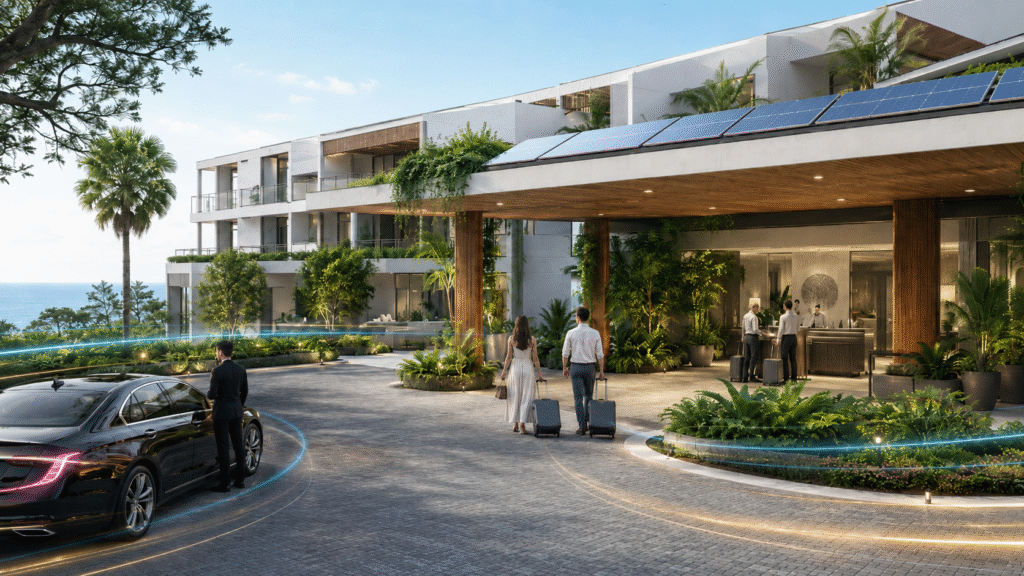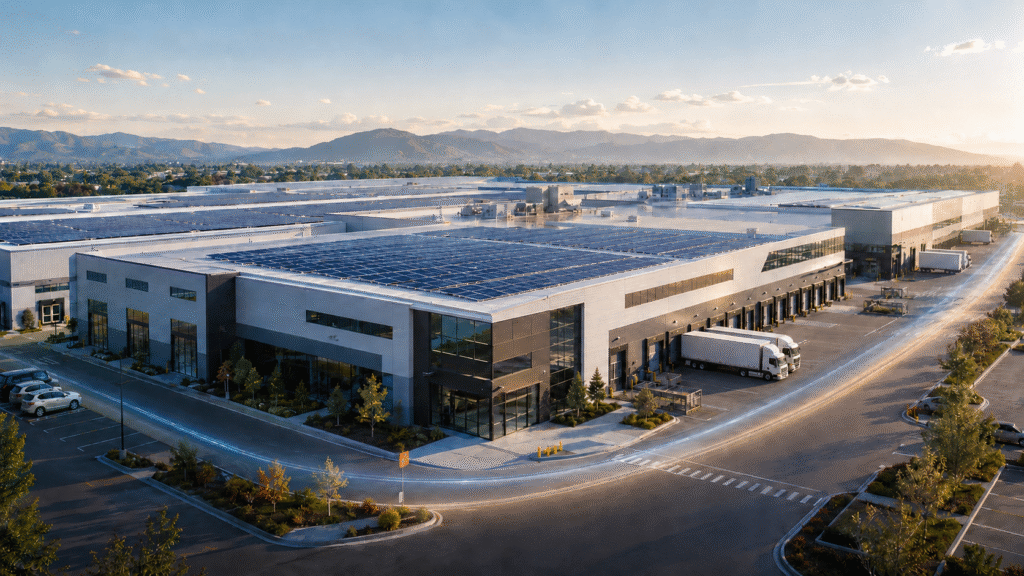
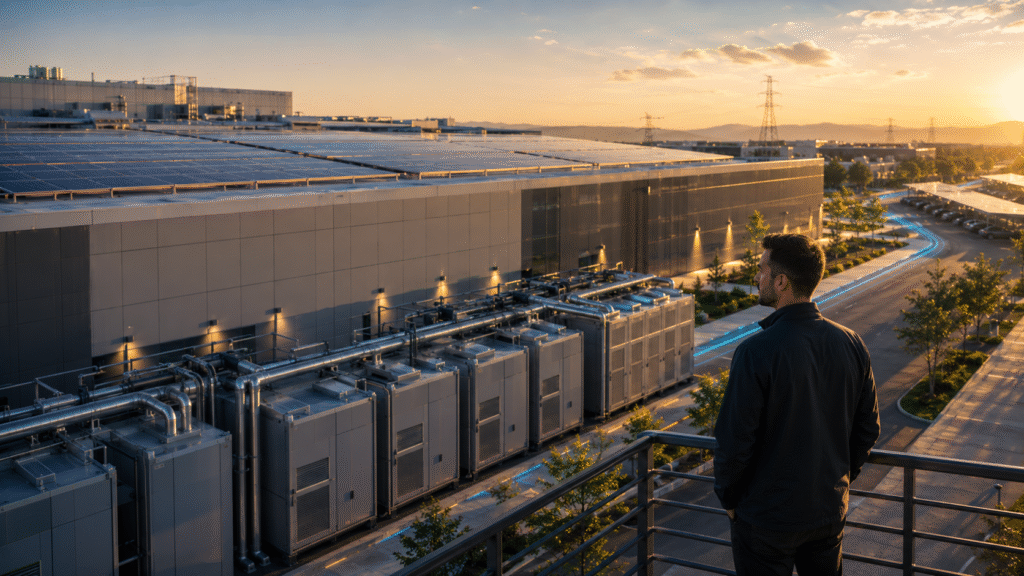
The future of technology has an energy problem. Smart facilities need an energy strategy.
Data centers, AI computing facilities, cold storage buildings, manufacturing plants, labs, and other high-energy operations do not use power casually.
They depend on it.
Every server, cooling system, compressor, pump, motor, charger, and backup system becomes part of the business model.
When energy costs rise, the pressure shows up in margins.
When the grid is constrained, growth can slow down.
When power fails, operations can be at risk.
When demand increases, the utility bill becomes harder to ignore.
For energy-intensive facilities, solar is not just about putting panels on a roof.
It is about building a smarter energy strategy around cost, capacity, resilience, and control.
Why Energy-Intensive Facilities Need a Different Solar Conversation
A small office, a warehouse, and a data center are not the same energy problem.
Energy-intensive facilities often need:
- high power capacity
- predictable operating costs
- 24/7 reliability
- backup systems
- cooling strategy
- demand charge management
- utility coordination
- expansion planning
- battery storage
- load forecasting
- power quality review
- long-term energy procurement
That means the solar conversation has to be more serious.
The question is not only:
“Can we install solar?”
The better question is:
“How should this facility control energy risk over the next 5, 10, or 20 years?”
That is where solar, storage, microgrids, utility strategy, and smart energy planning come together.
The Data Center Energy Reality
Data centers are becoming one of the clearest examples of why energy strategy matters.
The U.S. Department of Energy reported that data centers consumed about 4.4% of total U.S. electricity in 2023 and projected that they could consume roughly 6.7% to 12% of total U.S. electricity by 2028, depending on growth scenarios.
The International Energy Agency also projects that global data center electricity consumption could roughly double by 2030, reaching around 945 TWh in its base case, driven heavily by AI and digital infrastructure growth.
That does not mean every data center can simply “go solar” and solve the problem.
It means power has become strategic.
The companies that understand energy early will be in a better position than the ones that treat it as a utility bill forever.
Solar Alone Will Not Power Every Data Center
This needs to be said clearly.
A rooftop solar system alone is usually not enough to power a large data center or AI computing campus.
Data centers often use power 24 hours a day.
Solar produces during daylight hours.
Cooling loads can be constant.
Uptime requirements are serious.
Backup systems are mandatory.
Utility coordination can be complex.
So the answer is not:
“Just put solar panels on the roof.”
That is too simple.
The better answer is:
Solar can be one part of a larger energy architecture.
That architecture may include:
- onsite solar
- battery storage
- utility power
- backup generation
- load management
- energy procurement
- microgrid design
- renewable power agreements
- demand response
- cooling optimization
- phased expansion planning
For high-energy facilities, solar is not the whole solution.
It is one tool in the system.
Where Solar Can Still Help
Even if solar does not cover 100% of a facility’s load, it can still create value.
Solar may help:
- reduce daytime grid purchases
- offset part of cooling load
- lower long-term energy exposure
- support sustainability goals
- reduce peak-period costs when paired with storage
- support EV or fleet charging
- improve energy resilience planning
- reduce dependence on a single energy source
- support a broader clean energy strategy
For some facilities, the value of solar is direct savings.
For others, it is part of a layered risk strategy.
That distinction matters.
Energy-Intensive Facilities That May Benefit From Solar
This page is not only for data centers.
Solar and storage may also be relevant for:
- AI computing facilities
- server rooms
- telecom facilities
- cold storage warehouses
- food processing facilities
- manufacturing plants
- medical labs
- life science facilities
- hospitals and healthcare campuses
- cannabis cultivation facilities
- water treatment facilities
- EV fleet depots
- logistics hubs
- refrigeration-heavy retail
- hotels and resorts
- large schools or campuses
The common thread is simple:
These facilities use enough energy that energy planning becomes a business strategy.
The Core Problem: Energy Risk
For energy-intensive facilities, electricity is not a background expense.
It can affect:
- operating costs
- expansion timelines
- uptime
- product quality
- customer commitments
- cooling performance
- backup planning
- ESG goals
- investor perception
- tenant value
- long-term competitiveness
When a facility depends heavily on electricity, every energy decision becomes more important.
Solar can help reduce part of that exposure.
Battery storage can add control.
A microgrid can add resilience.
Utility strategy can determine whether growth is possible.
This is bigger than panels.
This is infrastructure.
Solar for Data Centers
Data centers have unique energy needs.
They may require:
- continuous power
- redundant systems
- cooling infrastructure
- backup generation
- power quality control
- utility coordination
- high-capacity interconnection
- uptime planning
- load forecasting
- sustainability reporting
Solar can support a data center energy strategy, but usually as part of a hybrid system.
For example, solar may help offset daytime energy usage or support a broader clean energy procurement plan.
Battery storage may help with peak demand, grid services, backup layers, or load shifting depending on design.
But a serious data center energy plan needs engineering.
Not slogans.
Sabio takeaway
For data centers, solar is not a decoration. It has to be part of a real power strategy.
Solar for Cold Storage and Refrigeration
Cold storage facilities are energy-intensive because refrigeration runs continuously.
That creates a different solar challenge.
Solar can produce during the day, but refrigeration loads may continue through the night.
That means the system should consider:
- refrigeration demand
- peak usage periods
- demand charges
- backup requirements
- temperature-sensitive inventory
- battery storage
- generator integration
- load shifting
- utility rates
- resilience planning
For cold storage, outages are not just inconvenient.
They can threaten inventory.
That makes energy resilience more valuable.
Sabio takeaway
Cold storage solar is not just about lowering bills. It is about protecting what is inside the building.
Solar for Labs and Healthcare Facilities
Labs, medical buildings, and healthcare campuses may have sensitive energy needs.
Power may support:
- refrigeration
- lab equipment
- ventilation
- HVAC
- medical devices
- clean rooms
- data systems
- emergency systems
- security
- lighting
These facilities may require higher reliability than ordinary commercial buildings.
Solar may help reduce energy costs, but battery storage and backup planning may matter just as much.
The system has to be designed around critical loads.
Not just total usage.
Sabio takeaway
For healthcare and lab environments, reliability is part of the value.
Solar for EV Fleet Depots
EV fleet depots can become major energy users.
Charging several vehicles at once can create large demand spikes.
That matters for:
- delivery fleets
- service vehicles
- buses
- logistics facilities
- municipal fleets
- warehouse fleets
- company vehicles
Solar can offset some charging energy.
Battery storage can help manage peak demand.
Smart charging can help schedule vehicle charging more efficiently.
But EV fleet charging should be planned before the chargers are installed — not after the bill jumps.
Sabio takeaway
Fleet charging is not just transportation. It is a new energy load.
Solar + Battery for High-Energy Facilities
Battery storage becomes more important when the facility needs control, not just production.
A battery may help with:
- peak shaving
- demand charge management
- load shifting
- backup support
- power smoothing
- EV charging support
- resilience planning
- grid services
- reducing expensive peak-period usage
But storage is not automatic.
It has to be sized around the actual problem.
A battery for demand charges is different from a battery for backup.
A battery for EV charging is different from a battery for critical loads.
A battery for a data center is different from a battery for a retail building.
Same technology category.
Different purpose.
Different design.
Microgrids: Powerful, But Not a Buzzword
A microgrid is a local energy system that can potentially operate with the grid or independently from it, depending on design.
For energy-intensive facilities, microgrids may include:
- solar
- batteries
- generators
- controls
- switchgear
- critical load panels
- monitoring
- utility interconnection
- energy management software
Microgrids can be valuable for facilities where uptime, resilience, and energy control are critical.
But they are also complex.
A microgrid is not just “solar plus battery.”
It is an engineered system.
Sabio takeaway
Microgrids can be powerful, but only when the facility truly needs that level of control.
Demand Charges and Peak Loads
Energy-intensive facilities often need to watch demand charges carefully.
A demand charge is based on the highest level of power pulled from the grid during a billing period.
For high-load facilities, peaks can come from:
- cooling systems
- compressors
- servers
- motors
- pumps
- EV chargers
- refrigeration cycles
- production equipment
- HVAC startup
- simultaneous system loads
Solar may reduce daytime grid purchases.
Battery storage may help reduce peak demand.
Load management may help avoid unnecessary spikes.
The right solution depends on when and why the peak happens.
Utility Capacity and Interconnection
For high-energy facilities, the utility conversation can be just as important as the solar design.
A facility may need to understand:
- available grid capacity
- transformer limits
- service upgrades
- interconnection timelines
- export limits
- standby charges
- demand charges
- metering requirements
- backup rules
- utility approval process
The DOE has highlighted data center deployment as a major factor in near-term electricity demand growth and noted that data centers could grow to consume up to 9% of U.S. electricity generation annually, based on EPRI estimates.
That level of growth means utilities, developers, businesses, and energy planners all need to think more carefully about capacity.
For energy-intensive facilities, power availability can become a site-selection issue.
Why 24/7 Loads Change the Solar Strategy
Many energy-intensive facilities do not operate like ordinary commercial buildings.
They may run:
- all day
- overnight
- weekends
- continuously
- seasonally at high intensity
- in cycles based on production or cooling
Solar produces during the day.
A 24/7 load needs a broader strategy.
That may include:
- daytime solar offset
- battery storage
- utility power
- offsite renewable procurement
- backup generation
- demand response
- efficiency improvements
- cooling optimization
- phased energy upgrades
The system has to match the load.
A generic solar proposal is not enough.
Energy Efficiency Still Matters
Before oversizing solar, high-energy facilities should also look at efficiency.
Efficiency may include:
- cooling optimization
- LED lighting
- HVAC controls
- compressor improvements
- insulation
- variable speed drives
- power management
- equipment scheduling
- smart charging
- building automation
This matters because the cheapest energy is often the energy the facility does not waste.
Solar can produce power.
Efficiency reduces the size of the problem.
Together, they can create a stronger strategy.
The Sustainability and ESG Layer
Energy-intensive facilities are often under pressure to explain their energy use.
Customers, investors, tenants, regulators, and communities may care about:
- carbon emissions
- renewable energy usage
- grid impact
- energy sourcing
- resilience
- reporting
- community impact
Solar can support sustainability goals, but the details matter.
A facility should understand:
- how much energy solar offsets
- whether renewable energy credits are retained
- how emissions reductions are calculated
- whether storage changes the profile
- whether offsite renewable procurement is needed
- how backup generation affects the picture
A sustainability claim should be real.
Not decorative.
Sabio takeaway
For high-energy facilities, clean energy messaging only works when the energy strategy is credible.
Red Flags in Solar Proposals for Energy-Intensive Facilities
Be careful if a proposal:
- ignores load profile
- ignores demand charges
- assumes solar alone solves 24/7 power needs
- does not discuss cooling loads
- skips backup requirements
- ignores utility capacity
- does not model storage properly
- treats a data center like a warehouse
- treats a manufacturing plant like an office
- gives savings estimates without assumptions
- does not explain interconnection risks
- uses “microgrid” as a buzzword without design details
- ignores future expansion
- does not identify critical loads
Energy-intensive facilities are too important for generic solar.
The system has to be engineered around the operation.
What Makes a High-Energy Facility a Strong Solar Candidate?
A strong candidate may have:
- high electricity usage
- meaningful daytime load
- usable roof, land, or parking space
- clear ownership or site control
- demand charges
- expansion plans
- EV charging plans
- resilience needs
- ESG goals
- high utility rates
- battery storage opportunity
- long-term facility timeline
- utility capacity concerns
- strong financial case
The best projects connect power needs, site conditions, utility rules, and business goals.
What Can Make the Project Difficult?
A project may be harder if:
- the load is mostly overnight
- the facility needs full backup without enough budget
- utility interconnection is constrained
- roof or land space is limited
- cooling loads are extreme
- electrical upgrades are major
- outage requirements are unclear
- demand charges are misunderstood
- the site may expand quickly
- financing does not match the project scale
- the proposal does not include serious engineering
These issues do not mean solar is impossible.
They mean the strategy needs to be honest.
The Emotional Side of Energy-Intensive Solar
Leaders of high-energy facilities do not just want lower bills.
They want confidence.
They want to know:
“Can we keep growing?”
“Can we control this cost?”
“Will power availability limit us?”
“Can we protect operations?”
“Will our energy strategy look credible to investors, customers, and partners?”
“Are we planning ahead, or reacting late?”
That is the emotional decision.
Energy uncertainty feels like risk.
A smarter energy strategy turns that risk into a plan.
The Sabio Way to Evaluate High-Energy Facilities
Sabio starts with the full energy picture.
1. Understand the load
Usage, peak demand, operating schedule, cooling, equipment, critical systems, and growth plans.
2. Review the utility structure
Rates, demand charges, interconnection, service capacity, export rules, and approval timelines.
3. Study the site
Roof, land, parking, structural capacity, electrical access, shading, and future expansion.
4. Compare energy strategies
Solar-only, solar + battery, EV charging, microgrid planning, backup integration, or phased deployment.
5. Build the business case
Cost control, resilience, sustainability, tax strategy, financing, operations, and long-term energy risk.
The goal is not the flashiest system.
The goal is the most intelligent energy plan.
Simple Example
Imagine two energy-intensive facilities.
Facility A
- cold storage warehouse
- strong daytime and nighttime load
- high refrigeration demand
- demand charges
- outage risk
Solar may help reduce daytime energy costs, but battery storage and backup planning may be essential to evaluate.
Facility B
- AI data center campus
- 24/7 computing load
- major cooling needs
- utility capacity concerns
- uptime requirements
Solar may be one piece of the strategy, but the larger plan may include storage, utility agreements, backup systems, offsite clean power, and microgrid-level planning.
Both are energy-intensive.
But the energy architecture is completely different.
So, Is Solar Worth It for Data Centers and Energy-Intensive Facilities?
Here is the clean answer:
Solar may be worth it for data centers and energy-intensive facilities when it is part of a broader strategy that accounts for load profile, uptime needs, utility capacity, storage, backup power, operating costs, and long-term energy risk.
Solar alone may not solve everything.
But solar can still be a valuable piece of the system.
The real opportunity is not just generating power.
It is gaining control.
Sabio Takeaway
Data centers and high-energy facilities are showing where business energy is headed.
Power is no longer just something companies buy.
It is something they have to plan, manage, store, protect, and optimize.
Solar can be part of that future.
Battery storage can add control.
Microgrids can add resilience.
Energy strategy can protect growth.
That is smarter business energy.
Ready to Build a Smarter Energy Strategy for Your Facility?
We’ll help you review your utility bills, facility profile, energy usage, and goals — then show you whether solar, battery storage, EV charging, or a phased commercial energy strategy makes sense.