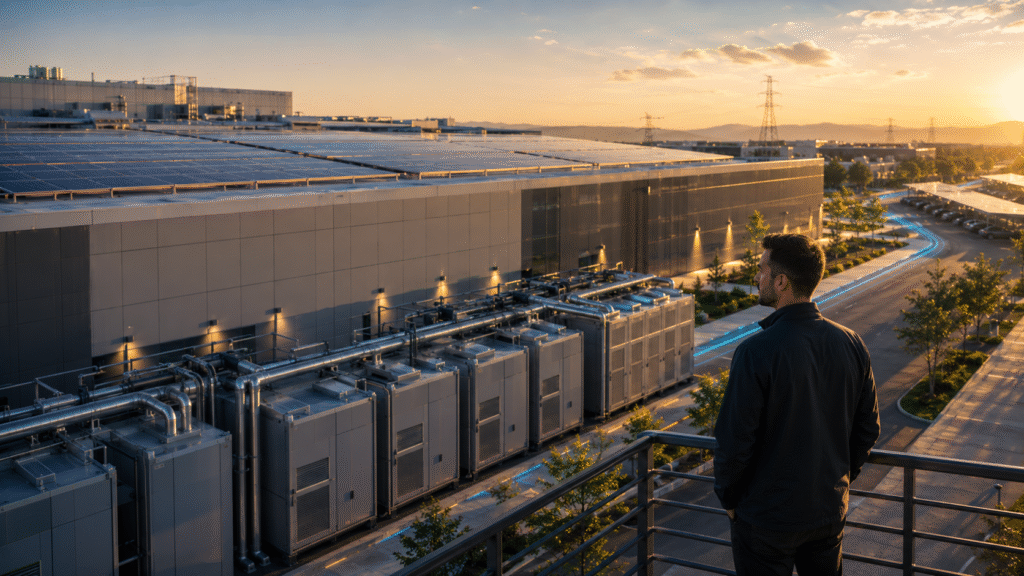
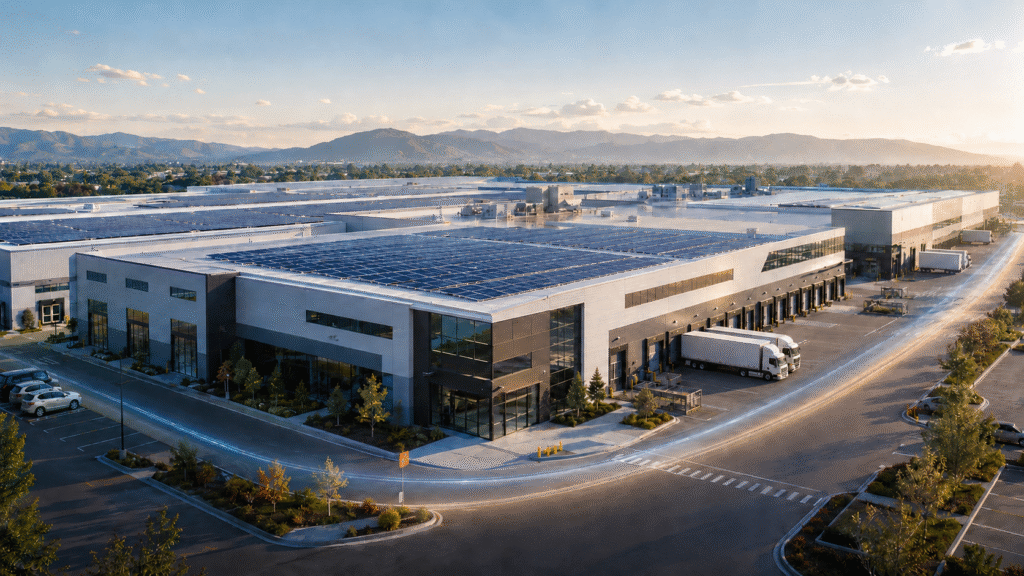
In manufacturing, energy is not just a bill. It is part of production.
Manufacturing facilities are built around output.
Machines run.
Equipment cycles.
Products move through the floor.
Air compressors, HVAC, motors, refrigeration, lighting, and control systems all pull power in the background.
And when energy costs rise, the pressure does not stay on the utility bill.
It can hit margins.
It can affect pricing.
It can complicate planning.
It can make operations feel more exposed.
For manufacturers, commercial solar is not just about clean energy.
It is about controlling one of the costs that keeps production moving.
Why Manufacturing Facilities Look at Solar
Manufacturing businesses often have serious electricity needs.
Energy may be used for:
- production equipment
- motors
- air compressors
- lighting
- HVAC
- ventilation
- refrigeration
- process cooling
- pumps
- conveyors
- robotics
- battery charging
- control systems
- offices and support areas
- EV or fleet charging
That makes energy strategy important.
A manufacturing facility does not just need power.
It needs reliable, predictable, cost-efficient power.
Solar can help reduce the amount of electricity the facility buys from the grid, especially during daytime production hours.
Battery storage may help manage peak demand, backup needs, or expensive usage patterns.
The right system depends on how the facility actually operates.
Manufacturing Solar Is Different From Basic Commercial Solar
A small office and a manufacturing plant are not the same energy problem.
Manufacturing facilities may have:
- higher electrical loads
- sudden demand spikes
- sensitive equipment
- production schedules
- expensive downtime
- 24/7 operations
- high HVAC or ventilation needs
- compressed air systems
- refrigeration or process cooling
- future equipment expansion
- backup power concerns
That means manufacturing solar should not be designed from a simple roof measurement.
It should be designed from the operation.
The question is not only:
“How much roof space do we have?”
The better question is:
“How does this facility use power, and where is energy creating risk?”
The Big Manufacturing Problem: Energy Affects Margins
Manufacturers already manage enough pressure.
Labor.
Materials.
Supply chain.
Equipment.
Shipping.
Quality control.
Customer deadlines.
Energy adds another layer.
When utility costs rise, the business may have limited options:
- absorb the cost
- raise prices
- reduce margins
- delay investment
- cut elsewhere
- accept more uncertainty
Solar can give manufacturers another lever.
It may not eliminate the utility bill.
But it can reduce exposure and make part of the energy cost more predictable over time.
That is the business value.
The Demand Charge Issue
Manufacturing facilities often need to pay attention to demand charges.
Demand charges are based on the highest level of power the facility pulls from the grid during a billing period.
In plain English:
Your bill may punish your biggest power spike.
That spike can come from:
- machinery startup
- motors ramping up
- compressors turning on
- HVAC peaks
- process equipment
- refrigeration cycles
- welders
- pumps
- conveyors
- multiple systems running at once
This is why a manufacturing solar proposal needs to look beyond total monthly usage.
A facility might use a lot of power steadily.
Or it might have short, expensive peaks.
Those are different problems.
Solar may help with daytime usage.
Battery storage may help with peak demand.
The right answer depends on the facility’s load profile.
Solar-Only for Manufacturing
Solar-only can make sense for manufacturing facilities with strong daytime energy use.
If the plant operates during daylight hours, solar production may line up well with facility demand.
Solar-only may help reduce power used for:
- production lines
- lighting
- HVAC
- ventilation
- office loads
- equipment
- charging systems
- support operations
This can lower grid purchases during the day and improve long-term energy planning.
Solar-only may work well when:
- the facility uses significant power during the day
- demand charges are not the main issue
- the roof has strong usable space
- the financial case works without storage
- backup power is not the priority
- operations are predictable
Sabio takeaway
Solar-only is often the cleanest first step when daytime production and solar production line up.
Solar + Battery for Manufacturing
Battery storage becomes more important when the facility needs more control.
For manufacturers, a battery may help with:
- demand charge management
- peak shaving
- load shifting
- backup support
- power resilience
- EV or equipment charging
- expensive peak periods
- smoother energy usage
This matters because manufacturing loads can be uneven.
A facility may run normally for hours, then suddenly hit a major spike when equipment starts or multiple systems operate at once.
A battery can help reduce the power pulled from the grid during those moments.
That can be valuable if demand charges are significant.
Sabio takeaway
Solar produces energy. Battery storage helps control the expensive moments.
Downtime Changes the Conversation
For some businesses, an outage is inconvenient.
For manufacturers, an outage can be expensive.
Lost production time can affect:
- order deadlines
- labor efficiency
- equipment restart time
- product quality
- refrigeration
- safety systems
- customer commitments
- revenue
- reputation
That does not mean every manufacturing facility needs full backup power from solar and batteries.
But it does mean backup needs should be discussed honestly.
Some facilities may only need critical load backup.
Others may need generator integration.
Some may need a larger resilience strategy.
Sabio takeaway
Backup power is not a checkbox. It is a design decision.
Critical Loads vs. Whole-Facility Backup
This is an important distinction.
A commercial battery may not automatically back up the entire manufacturing facility.
The system may be designed to support only critical loads, such as:
- controls
- servers
- emergency lighting
- refrigeration
- safety systems
- security
- select production equipment
- communications
- building management systems
Whole-facility backup is a much larger and more expensive design challenge.
Before assuming backup, ask:
- What equipment must stay online?
- How long must it run?
- What can safely shut down?
- What requires controlled shutdown?
- Is a generator already onsite?
- Should solar, battery, and generator work together?
- What is the cost of downtime?
Sabio takeaway
The right backup strategy starts with what the business cannot afford to lose.
Compressed Air, Motors, and Equipment Spikes
Many manufacturing facilities have hidden energy drivers.
Compressed air systems, motors, pumps, and process equipment can create meaningful demand.
Sometimes the biggest energy opportunity is not just solar.
It is understanding how the facility uses power.
Before designing solar, manufacturers should review:
- equipment startup patterns
- compressor schedules
- motor loads
- HVAC peaks
- production shifts
- idle energy use
- maintenance schedules
- process cooling loads
- equipment expansion plans
Solar can be part of the solution.
But the full opportunity may involve load management, storage, efficiency upgrades, or phased energy planning.
Sabio takeaway
The smarter the energy data, the smarter the solar design.
Manufacturing Facilities With 24/7 Operations
Some facilities operate around the clock.
That changes the solar strategy.
Solar produces during the day, but the facility may use power at night as well.
That does not mean solar is a bad fit.
It means the project needs to consider:
- daytime offset
- nighttime usage
- storage value
- rate structure
- demand charges
- export rules
- backup needs
- production schedules
- utility pricing
For 24/7 facilities, solar may still reduce a meaningful portion of energy costs.
But storage, demand management, and utility rate analysis may become more important.
Sabio takeaway
A 24/7 facility needs a 24/7 energy strategy.
Roof Space and Manufacturing Buildings
Manufacturing facilities may have large roofs, but not all roof space is usable.
The system has to work around:
- HVAC units
- vents
- skylights
- stacks
- drains
- structural limits
- roof age
- maintenance access
- fire pathways
- shading
- roof warranties
- future equipment needs
Some facilities may also have land or parking areas that can support ground-mounted solar or solar carports.
The roof shows the opportunity.
The engineering shows what is realistic.
Ground-Mount Solar and Carports
Not every manufacturing project has to be rooftop solar.
Some facilities may have:
- unused land
- large parking lots
- truck staging areas
- employee parking
- open industrial space
Ground-mounted solar or solar carports may help add capacity when roof space is limited or complicated.
Solar carports may also support:
- employee EV charging
- fleet charging
- shaded parking
- visible sustainability goals
- additional solar production
Sabio takeaway
For manufacturing, the energy asset may be the roof, the land, the parking lot, or a combination of all three.
EV Charging and Fleet Electrification
Manufacturers may need to plan for more electrification.
That could include:
- employee EV charging
- fleet vehicles
- forklifts
- delivery vehicles
- service vehicles
- charging for vendors or logistics partners
EV charging can increase energy usage and create new demand spikes.
That means it should be planned alongside solar and battery storage.
Before adding chargers, ask:
- How many vehicles will charge?
- When will charging happen?
- How fast do they need to charge?
- Will charging overlap with production peaks?
- Will demand charges increase?
- Is battery storage useful?
- Is the electrical service ready?
Sabio takeaway
EV charging is not just a plug. It is a new load on the business.
Incentives and Tax Strategy
Manufacturing businesses may be able to benefit from commercial solar incentives depending on location, ownership structure, project eligibility, and tax position.
The conversation may include:
- federal tax credits
- depreciation
- state incentives
- utility programs
- battery storage incentives
- domestic content considerations
- financing structure
- tax appetite
But this should not be guessed.
A solar company can help explain the project.
A tax professional should confirm how incentives apply to the business.
Sabio takeaway
Incentives can improve the project, but the system still needs to make operational sense.
What Makes a Manufacturing Facility a Strong Solar Candidate?
A manufacturing facility may be a strong candidate if it has:
- high electricity usage
- strong daytime production
- large usable roof, land, or parking space
- clear property control
- demand charges
- predictable operating schedules
- long-term facility plans
- strong sun exposure
- roof condition that supports solar
- interest in storage or resilience
- future EV or equipment expansion
- a clear financial goal
The best projects connect the facility’s energy pattern to the business case.
What Can Make Manufacturing Solar More Difficult?
Manufacturing solar may be harder if:
- the roof is old or structurally limited
- equipment creates heavy shading
- electrical systems need major upgrades
- production cannot tolerate disruption
- demand peaks happen outside solar production hours
- utility rules are unfavorable
- backup requirements are unclear
- financing does not fit
- the business may relocate
- the project ignores operational complexity
These issues do not mean solar is impossible.
They mean the project needs proper planning.
Manufacturing solar should never be treated as a generic installation.
The Emotional Side of Manufacturing Solar
Manufacturing owners and operators do not just want clean energy.
They want confidence.
They want to know:
“Will this actually reduce costs?”
“Will this disrupt production?”
“Will this protect margins?”
“Will this help us plan better?”
“Will this make us more resilient?”
“Are we making a smart long-term investment?”
That is the emotional side of the decision.
Energy uncertainty creates pressure.
Solar can help turn some of that pressure into control.
The Sabio Way to Evaluate Manufacturing Solar
Sabio starts with how the facility actually operates.
1. Review the utility bill
Usage, demand charges, rate structure, seasonal patterns, and peak demand.
2. Understand the operation
Production hours, equipment, compressors, motors, refrigeration, HVAC, and shift schedules.
3. Study the site
Roof, structure, electrical access, land, parking, shading, and utility connection.
4. Model system options
Solar-only, solar + battery, backup support, EV charging, ground-mount, or phased strategy.
5. Build the business case
Savings, demand reduction, resilience, financing, incentives, maintenance, and long-term facility goals.
The right manufacturing solar project is not just installed.
It is engineered around production.
Simple Example
Imagine two manufacturing facilities.
Facility A
- daytime production
- steady equipment usage
- large usable roof
- low outage risk
- moderate demand charges
Solar-only may be a strong fit.
Facility B
- 24/7 operations
- high equipment spikes
- refrigeration loads
- expensive demand charges
- outage risk
- future EV charging
Solar + battery, backup planning, and load management may create a stronger strategy.
Same industry.
Different facility.
Different system.
So, Is Solar Worth It for Manufacturing Facilities?
Here is the clean answer:
Solar may be a strong fit for manufacturing facilities when the business has meaningful electricity usage, usable roof or land space, clear facility control, and an energy strategy built around real production patterns.
For some manufacturers, solar-only may be enough.
For others, solar + battery, EV charging, backup planning, or a phased energy strategy may create more value.
The right system depends on the facility.
Not the pitch.
Sabio Takeaway
Manufacturing runs on power.
Solar can help make that power more predictable, more strategic, and more controlled.
It can reduce energy costs.
It can support long-term planning.
It can help manage demand.
It can improve resilience.
It can turn unused roof or land into a business asset.
That is smarter business energy.
Ready to See What Solar Could Do for Your Manufacturing Facility?
We’ll help you review your utility bills, facility profile, energy usage, and goals — then show you whether solar, battery storage, EV charging, or a phased commercial energy strategy makes sense.