
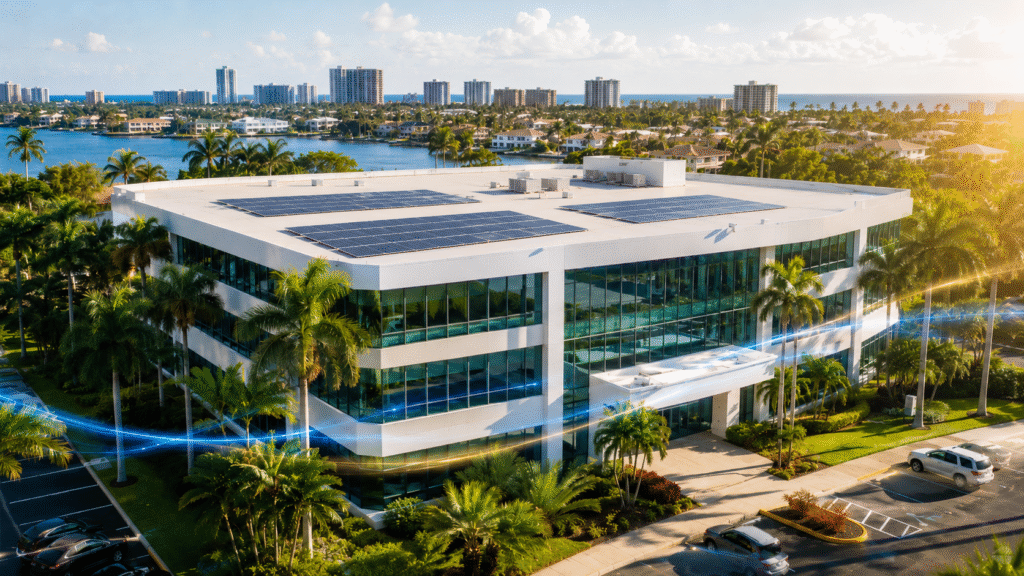
Your office building is more than square footage. It is an energy asset.
Office buildings are designed around productivity.
People work there.
Tenants operate there.
Meetings happen there.
HVAC systems run all day.
Lights, elevators, servers, security systems, and charging stations quietly use power in the background.
And every month, the building’s utility bill tells part of the story.
For office building owners, landlords, property managers, corporate campuses, medical offices, and commercial real estate investors, solar can turn an ordinary building into a smarter long-term asset.
Not just because it lowers energy costs.
But because it helps the property feel more modern, more efficient, and more prepared for where business energy is going.
Why Office Buildings Can Be Strong Candidates for Solar
Office buildings often use a lot of power during the day.
That matters because solar panels produce power during the day.
This natural overlap can make solar a practical fit for many office properties.
Office energy use may include:
- lighting
- HVAC
- elevators
- computers
- servers
- conference rooms
- security systems
- tenant spaces
- common areas
- parking garages
- EV chargers
- medical or professional equipment
Solar can help offset part of that daytime usage and reduce how much electricity the building buys from the grid.
For some buildings, that can mean lower operating costs.
For others, it can support tenant value, sustainability goals, or long-term property positioning.
Office Solar Is Not Just About Savings
Lower bills matter.
But office solar is bigger than that.
For commercial real estate, solar can support:
- lower operating expenses
- better energy predictability
- tenant attraction
- tenant retention
- ESG goals
- brand perception
- property modernization
- EV charging readiness
- resilience planning
- long-term asset value
A building with solar can send a quiet message:
This property is being managed for the future.
That matters to tenants, buyers, investors, employees, and companies with sustainability goals.
The Tenant Value Angle
Office buildings often compete for tenants.
Tenants compare location, rent, amenities, parking, building quality, operating costs, and brand image.
Energy strategy can become part of that conversation.
Solar may help a property owner offer:
- lower common-area energy costs
- cleaner building operations
- visible sustainability features
- EV charging options
- better ESG alignment for tenants
- a more modern property story
For some tenants, especially companies with climate, ESG, or corporate responsibility goals, the building’s energy profile matters.
Solar does not replace location or price.
But it can strengthen the building’s value story.
Owner-Occupied vs. Tenant-Occupied Office Buildings
The solar strategy changes depending on who uses the building.
Owner-occupied office building
This is often simpler.
The business owns or controls the building and directly benefits from lower energy costs.
Solar can be evaluated around:
- utility savings
- tax strategy
- long-term ownership
- battery storage
- EV charging
- backup power
- corporate sustainability goals
Tenant-occupied office building
This is more complex.
The property owner may own the roof, but tenants may pay some or all of the electric bills.
That raises questions:
- Who pays the utility bill?
- Who owns the solar system?
- Who receives the savings?
- Are tenant meters separate?
- Are common areas separately metered?
- Can solar reduce operating expenses?
- Can savings be shared?
- Does the lease allow roof improvements?
- Would a PPA or lease structure work better?
Sabio takeaway
Office solar works best when the property structure and energy savings are aligned.
Solar for Common Areas
In many office buildings, the landlord may be responsible for common-area energy use.
That may include:
- lobby lighting
- hallways
- elevators
- parking garages
- exterior lighting
- security systems
- shared HVAC
- common amenities
- building management systems
Solar may help reduce some of these costs depending on how the building is metered.
For landlords, this can support lower operating expenses and better long-term cost control.
For tenants, it may support a more efficient and future-ready building.
Solar for Corporate Offices and Campuses
Corporate offices and campuses can be strong candidates because they often have larger buildings, parking areas, and long-term energy goals.
Solar may help support:
- corporate sustainability commitments
- reduced operating expenses
- EV charging for employees
- backup power planning
- public brand perception
- employee experience
- long-term energy strategy
For corporate campuses, the opportunity may go beyond rooftop solar.
It may include:
- rooftop solar
- solar carports
- battery storage
- EV charging
- microgrid planning
- energy monitoring
- phased expansion
Sabio takeaway
For corporate properties, solar is not just a building upgrade.
It is part of the company’s energy identity.
Solar for Medical and Professional Office Buildings
Medical offices, dental offices, labs, and professional buildings can have specific energy needs.
They may use power for:
- HVAC
- lighting
- medical equipment
- refrigeration
- computers
- imaging equipment
- security systems
- elevators
- backup systems
Some facilities may also care about resilience because even short outages can interrupt appointments, systems, refrigeration, or equipment.
Solar can help reduce energy costs, while battery storage may be worth exploring for critical loads.
Sabio takeaway
For medical and professional offices, energy reliability can matter as much as savings.
Solar Carports for Office Parking Lots
Many office buildings and campuses have parking lots or garages.
That space can become part of the energy strategy.
Solar carports may help:
- generate onsite power
- shade employee and visitor vehicles
- support EV charging
- create a visible sustainability feature
- improve property perception
- add solar capacity when roof space is limited
Carports are typically more expensive than simple rooftop systems, but they can make sense when parking, EV charging, visibility, and employee experience matter.
For offices, this can be especially useful because employees may park for several hours during the day — the same time solar is producing.
EV Charging and the Future of Office Energy
EV charging is becoming a bigger part of office building planning.
Employees, tenants, visitors, and corporate fleets may all need charging access.
But EV charging can create new demand on the building.
A few chargers may be manageable.
A larger charging program may require a smarter strategy.
Before adding EV chargers, office buildings should consider:
- number of chargers
- charging speed
- employee dwell time
- tenant demand
- visitor use
- parking layout
- demand charges
- electrical capacity
- solar production
- battery storage
- future expansion
Sabio takeaway
EV charging is not just an amenity.
It changes the building’s energy profile.
Solar and storage should be planned around that future.
The Demand Charge Issue
Office buildings may face demand charges depending on the utility rate structure.
Demand charges are based on peak power draw, not just total energy use.
In office buildings, demand spikes can come from:
- HVAC startup
- elevators
- EV chargers
- large tenant loads
- server rooms
- equipment
- multiple systems running at once
Solar may help reduce daytime energy purchases.
Battery storage may help manage peak demand if the building has expensive demand spikes.
The key is understanding the load profile.
Not just the monthly bill total.
Solar + Battery for Office Buildings
Battery storage may make sense for office buildings when the goal is more than simple savings.
A battery may help with:
- demand charge management
- peak shaving
- backup support
- EV charging support
- time-of-use rate management
- resilience planning
- critical load protection
But storage is not automatically needed.
For some office properties, solar-only may be the cleanest financial move.
For others, especially buildings with high demand charges, critical systems, or EV charging plans, storage may be worth modeling.
Sabio takeaway
Solar helps produce power.
Storage helps control when that power matters most.
What Makes an Office Building a Strong Solar Candidate?
An office property may be a strong candidate if it has:
- high daytime electricity usage
- usable roof space
- parking areas for carports
- good sun exposure
- long-term ownership
- clear roof rights
- strong tenant demand
- ESG goals
- EV charging plans
- demand charges
- common-area energy costs
- roof condition that supports long-term solar
The strongest projects connect the building’s energy use with the owner’s business goals.
What Can Make Office Solar More Difficult?
Office solar may be more difficult if:
- the roof is old
- the roof is crowded with equipment
- tenants have separate meters
- savings allocation is unclear
- the property may be sold soon
- the lease structure is complicated
- electrical capacity is limited
- shading is significant
- utility rules are unfavorable
- the financing structure does not fit
- the project disrupts tenants too much
These issues do not automatically stop a project.
But they need to be addressed early.
Commercial solar should reduce uncertainty.
Not create more of it.
The Landlord-Tenant Problem
Office buildings often have one major challenge:
The person who owns the roof may not be the person paying the electric bill.
That creates what is sometimes called a split incentive.
The landlord controls the building.
The tenant uses the power.
The utility bills may be separate.
The savings may not automatically flow to the owner.
This does not mean solar cannot work.
It means the structure matters.
Possible approaches include:
- landlord-owned solar for common areas
- tenant-specific solar agreements
- green lease terms
- shared savings structure
- PPA
- solar carports for shared property loads
- EV charging revenue model
- portfolio-wide strategy
Sabio takeaway
For office buildings, the solar deal has to match the lease structure.
Otherwise, the numbers may look good on paper but fail in practice.
Commercial Real Estate and Property Value
Solar may support commercial real estate value by helping reduce operating costs, improving property positioning, and supporting tenant expectations.
But property value depends on the details.
A buyer or investor will want to understand:
- who owns the solar system
- whether financing transfers
- whether the system reduces expenses
- how savings are documented
- whether tenants benefit
- whether maintenance is clear
- how warranties transfer
- whether roof condition is protected
- how the system affects net operating income
For commercial real estate, solar is strongest when it is easy to understand.
The cleaner the structure, the easier it is to explain the value.
Portfolio Solar Strategy
Some commercial real estate owners manage multiple buildings.
For them, solar may be evaluated across a portfolio.
That allows the owner to compare:
- utility rates
- roof quality
- tenant structures
- incentives
- electricity usage
- demand charges
- EV charging potential
- building ownership timeline
The smartest move may not be installing solar on every property.
It may be starting with the buildings where the business case is strongest.
Sabio takeaway
For property portfolios, solar should be prioritized by opportunity — not emotion.
The Emotional Side of Office Solar
Office building owners do not just want panels.
They want their property to feel competitive.
They want tenants to see value.
They want operating costs to feel more controllable.
They want the building to feel modern, efficient, and prepared.
They want to avoid making a costly mistake.
That is the emotional side of the decision.
Solar helps an office building feel less passive.
It makes the property work harder.
The Sabio Way to Evaluate Office Solar
Sabio looks at office solar through the full property picture.
1. The energy bill
Usage, demand charges, rate structure, common-area loads, seasonal patterns.
2. The building
Roof condition, usable space, electrical access, shading, structural capacity.
3. The ownership model
Owner-occupied, landlord-tenant, corporate campus, medical office, or multi-tenant property.
4. The tenant and business strategy
Tenant value, ESG goals, operating costs, EV charging, property positioning.
5. The financial structure
Cash, loan, lease, PPA, tax strategy, shared savings, or phased rollout.
The right office solar project is not generic.
It is designed around the building’s actual role as a business asset.
Simple Example
Imagine two office buildings.
Building A
- owner-occupied corporate office
- strong daytime energy use
- long-term ownership
- parking lot available
- EV charging planned
A rooftop solar + EV charging strategy may be a strong fit.
Building B
- multi-tenant office building
- separate tenant meters
- landlord controls roof
- common-area energy is modest
- roof needs replacement soon
Solar may still work, but the ownership structure and roof condition need to be solved first.
Same category.
Different project.
Different strategy.
So, Is Solar Worth It for Office Buildings?
Here is the clean answer:
Solar may be a strong fit for office buildings when the property has daytime energy usage, usable roof or parking space, clear ownership structure, tenant or ESG value, and a financial case that supports the investment.
For some offices, solar-only is enough.
For others, solar + battery, EV charging, carports, or a phased strategy may create more value.
The right answer depends on the building.
Not the trend.
Sabio Takeaway
An office building is not just a place people work.
It is a long-term operating asset.
Solar can help that asset work smarter.
It can reduce costs.
It can support tenants.
It can prepare for EV charging.
It can improve the property story.
It can make the building feel more future-ready.
That is smarter business energy.
Ready to See What Solar Could Do for Your Office Building?
We’ll help you review your utility bills, facility profile, energy usage, and goals — then show you whether solar, battery storage, EV charging, or a phased commercial energy strategy makes sense.