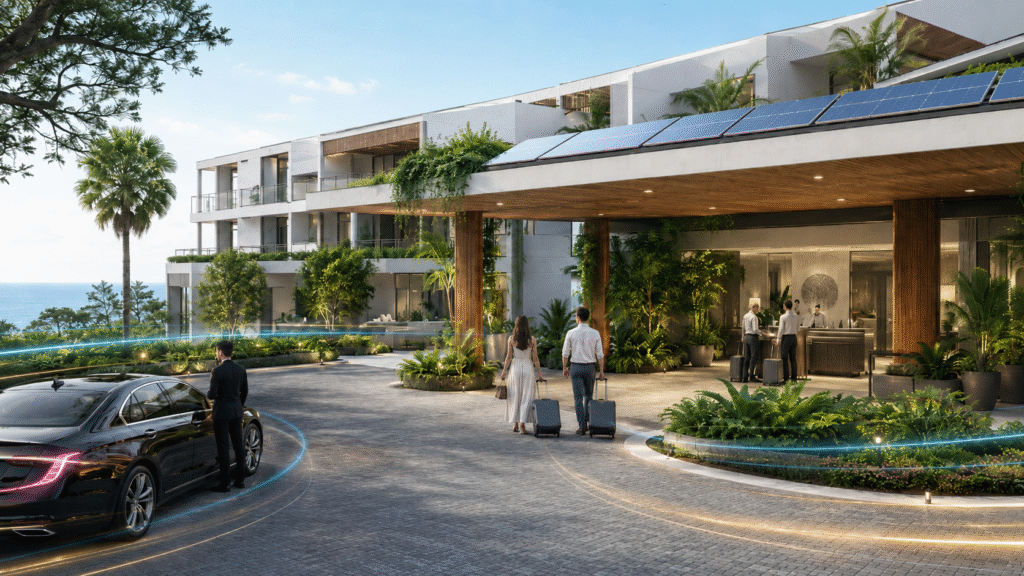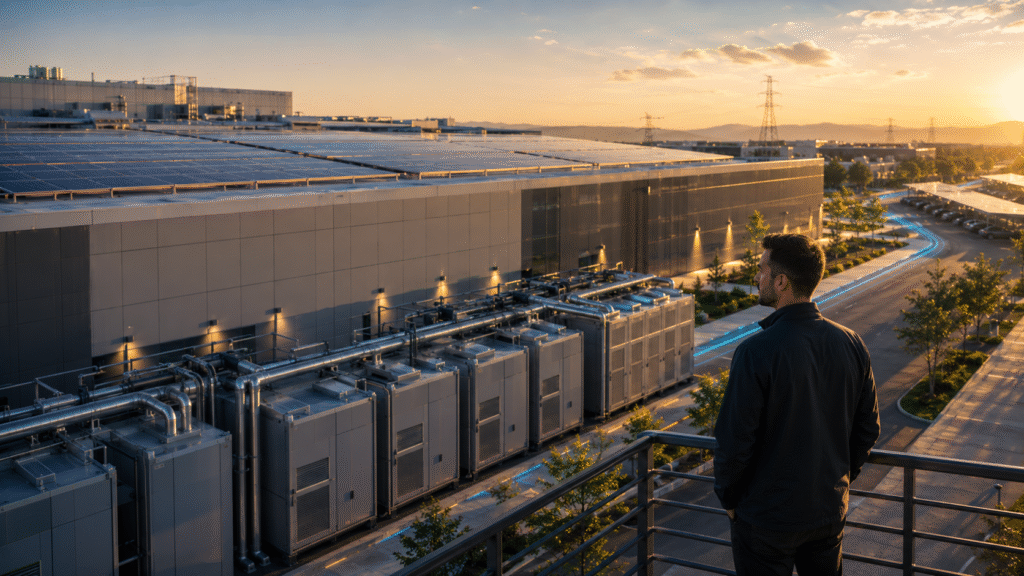
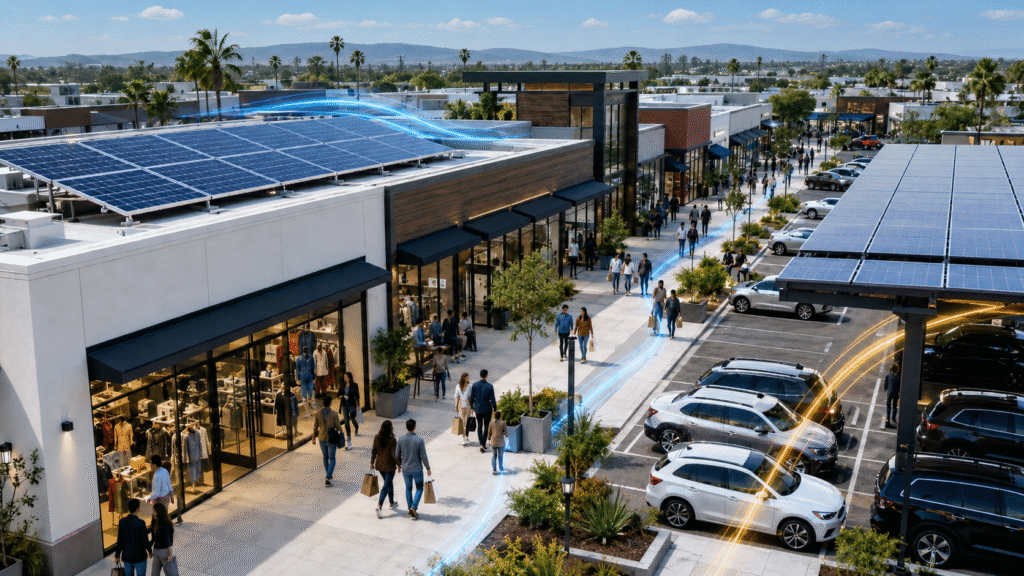
Your retail property does more than house businesses. It can help power them.
Retail buildings are built around visibility, traffic, convenience, and customer experience.
Stores need lighting.
Restaurants need refrigeration.
Gyms need HVAC.
Shopping centers need parking lots, signage, security, and constant power.
Every day, energy is working in the background.
And every month, the utility bill reminds you what that energy costs.
For retail property owners, shopping center operators, restaurants, supermarkets, gyms, and multi-tenant commercial buildings, solar can turn unused roof space or parking areas into a smarter business asset.
Not just for sustainability.
For cost control.
For tenant value.
For brand perception.
For long-term energy strategy.
Why Retail Buildings Are Strong Candidates for Solar
Retail properties can be a strong fit for commercial solar because many of them use power during the day — the same time solar panels are producing.
That daytime usage may include:
- lighting
- HVAC
- refrigeration
- kitchen equipment
- point-of-sale systems
- signage
- security systems
- office areas
- elevators
- escalators
- EV chargers
- parking lot lighting
Solar can help reduce how much electricity the property or business buys from the grid during operating hours.
That makes retail solar practical.
And practical is what matters.
Retail Solar Is Not Just About the Electric Bill
Lowering electricity costs is important.
But retail solar can also support a bigger property strategy.
Solar may help:
- reduce operating expenses
- improve long-term energy predictability
- make a property more attractive to tenants
- support ESG or sustainability goals
- improve customer perception
- support EV charging
- reduce exposure to rising utility rates
- turn unused roof or parking space into productive infrastructure
For retail buildings, solar can be part of the property’s value story.
It says:
This building is not just occupied. It is being managed intelligently.
The Multi-Tenant Challenge
Shopping centers and retail buildings often have multiple tenants.
That can make solar more complex.
The key question is:
Who pays the electric bill, and who benefits from the solar?
In a retail property, electricity may be structured in different ways:
- landlord-paid common area usage
- tenant-paid utility accounts
- shared meters
- separate meters
- common area maintenance charges
- master-metered buildings
- landlord-controlled roof space
- tenant-controlled buildouts
This matters because the solar design and financing structure need to match the property structure.
A landlord may want solar for common areas.
A tenant may want solar to lower its own bill.
A shopping center owner may want solar to improve property economics.
A national retailer may want solar across multiple locations.
Different ownership structure.
Different strategy.
Solar for Shopping Centers
Shopping centers can be especially interesting because they often have two major energy opportunities:
1. Large roof space
Many shopping centers have wide, low-rise roof areas that may be usable for solar.
2. Large parking lots
Parking lots can support solar carports, EV charging, shaded parking, and customer-facing clean energy upgrades.
Solar carports may cost more than rooftop solar, but they can add visible value.
They can provide:
- shade for customers
- EV charging support
- additional solar capacity
- better use of parking areas
- a visible sustainability signal
For some retail centers, the roof is the energy asset.
For others, the parking lot may be just as important.
Solar for Restaurants
Restaurants can have serious electricity needs.
Energy use may come from:
- refrigeration
- freezers
- kitchen equipment
- lighting
- HVAC
- ventilation
- dishwashing
- point-of-sale systems
- outdoor lighting
- signage
Restaurants may also have long operating hours, evening peaks, and equipment that cycles throughout the day.
Solar can help, but the system should be designed around the restaurant’s actual usage pattern.
A restaurant that uses most of its power in the afternoon may be different from one with stronger evening demand.
Battery storage may be worth reviewing if demand charges, peak pricing, or backup needs are important.
Sabio takeaway
For restaurants, solar is not just about panels.
It is about managing a building that never stops using energy.
Solar for Supermarkets and Grocery Stores
Supermarkets and grocery stores can be strong candidates because refrigeration, lighting, HVAC, and equipment can create steady energy demand.
But they also need careful planning.
Important questions include:
- How much energy does refrigeration use?
- When do demand peaks happen?
- Are there demand charges?
- What happens during an outage?
- Is backup power needed for critical loads?
- Could battery storage protect operations?
- Is the roof usable?
- Are there future EV charging plans?
For grocery stores, energy is not only an expense.
It is connected to product protection.
That changes the conversation.
Sabio takeaway
For grocery and food retail, solar can reduce costs, but resilience may be just as important.
Solar for Gyms and Fitness Centers
Gyms can use a lot of electricity because of:
- HVAC
- lighting
- ventilation
- equipment
- showers and hot water systems
- extended operating hours
- signage
- music and media systems
Many gyms operate early mornings, evenings, and weekends.
That means solar may help during the day, but the full energy pattern matters.
Battery storage or rate optimization may be worth reviewing if peak pricing or demand charges are significant.
Sabio takeaway
For gyms, comfort is part of the business. Energy strategy helps protect that experience.
Solar for Retail Chains
Retail chains may benefit from solar across multiple locations.
The value is not only at one building.
It may be in the portfolio.
Multi-site solar can help businesses:
- compare locations
- prioritize high-bill properties
- standardize energy strategy
- support corporate sustainability goals
- reduce long-term operating costs
- prepare for EV charging
- strengthen brand perception
- make energy planning more predictable
But multi-site solar also requires discipline.
Not every location should be treated the same.
Some stores may have better roofs.
Some may have better rates.
Some may have stronger incentives.
Some may have lease restrictions.
Some may need storage.
Some may not make sense yet.
Sabio takeaway
For retail chains, the smartest strategy is not solar everywhere.
It is solar where the business case is strongest first.
The Demand Charge Issue
Commercial retail buildings may face demand charges depending on utility structure.
Demand charges are based on peak power draw, not just total electricity used.
In retail settings, demand spikes can come from:
- HVAC startup
- refrigeration cycles
- kitchen equipment
- elevators or escalators
- EV chargers
- multiple tenants operating at once
- lighting and cooling loads overlapping
This is why retail solar needs more than a simple monthly bill review.
A property owner should understand when the building uses the most power.
Solar may reduce daytime energy purchases.
Battery storage may help manage demand spikes.
The right strategy depends on the load profile.
Solar + Battery for Retail Properties
Battery storage may make sense when a retail property needs more control.
A battery can help with:
- peak shaving
- demand charge management
- backup support
- load shifting
- EV charging support
- refrigeration protection
- time-of-use rate management
But storage is not automatic.
It adds cost and complexity.
For some retail properties, solar-only may be enough.
For others, especially grocery stores, restaurants, shopping centers, or properties adding EV charging, storage may deserve a closer look.
Sabio takeaway
Solar lowers energy use from the grid.
Storage helps control when energy matters most.
EV Charging for Retail Centers
EV charging can become a strong retail advantage.
For shopping centers, restaurants, supermarkets, gyms, and mixed-use retail properties, EV chargers can help attract customers and support future transportation trends.
But EV charging also changes the energy profile.
Chargers can create new demand spikes if several vehicles charge at once.
That means EV charging should be planned with:
- solar production
- battery storage
- demand charges
- parking layout
- customer dwell time
- charger speed
- future expansion
- utility capacity
EV charging is not just an amenity.
It is an energy planning decision.
Sabio takeaway
If your parking lot is part of the customer experience, it may also become part of your energy strategy.
Solar Carports for Retail Parking Lots
Retail properties often have large parking areas.
Solar carports can turn those spaces into energy-producing structures.
They may help:
- produce onsite power
- shade customer vehicles
- support EV charging
- improve the appearance of the property
- create a visible clean-energy feature
- increase usable solar capacity when roof space is limited
Carports can be more expensive than rooftop solar, but they can make sense when visibility, EV charging, shade, and additional energy production matter.
For retail, visibility can be part of the value.
Customers can see the investment.
Tenants can see the improvement.
The property feels more modern.
What Makes a Retail Property a Strong Solar Candidate?
A retail building or shopping center may be a strong candidate if it has:
- high electric bills
- strong daytime usage
- usable roof space
- usable parking areas
- clear ownership or roof rights
- long-term property control
- demand charges
- refrigeration or HVAC loads
- EV charging plans
- tenant value goals
- sustainability goals
- good sun exposure
- roof condition that supports long-term solar
The best retail solar projects connect the property, the tenants, and the energy strategy.
What Can Make Retail Solar More Difficult?
Retail solar may be harder if:
- roof rights are unclear
- tenants pay separate utility bills
- the roof is old or crowded
- electrical systems are outdated
- the property may be sold soon
- shading is heavy
- parking disruption is difficult
- utility rules are unfavorable
- financing does not match the ownership structure
- savings are not clearly allocated
These issues do not automatically stop a project.
But they need to be solved early.
A retail solar project should not create confusion between landlord, tenants, and utility accounts.
The Landlord-Tenant Solar Question
This is one of the most important parts of retail solar.
If the landlord owns the roof but tenants pay the electric bills, the project needs a structure that aligns benefits.
Possible approaches may include:
- landlord-owned solar for common areas
- tenant-specific solar arrangements
- shared savings model
- lease addendum
- green lease structure
- PPA
- solar carport serving common loads
- EV charging revenue model
- multi-tenant energy allocation
The wrong structure creates friction.
The right structure creates value.
Sabio takeaway
Retail solar is strongest when the people who control the property and the people who use the energy both understand the benefit.
The Emotional Side of Retail Solar
Retail owners and operators do not just want lower bills.
They want the property to feel more competitive.
They want tenants to stay.
They want customers to see a modern building.
They want operating costs to feel less unpredictable.
They want to use the space better.
They want to feel like they are making a smart long-term move instead of reacting to rising costs later.
That is the emotional value.
Solar helps the property feel less passive.
It makes the building work harder.
The Sabio Way to Evaluate Retail Solar
Sabio looks at the full property picture.
1. The bill
Usage, demand charges, common area loads, tenant accounts, rate structure.
2. The building
Roof condition, usable area, shading, electrical access, structural capacity.
3. The property model
Owner-occupied, landlord-tenant, shopping center, chain location, or mixed-use retail.
4. The customer experience
Parking, EV charging, shade, visibility, disruption, signage, brand perception.
5. The financial structure
Cash, loan, lease, PPA, shared savings, tax strategy, or phased rollout.
The goal is not just to install solar.
The goal is to make the property more valuable, efficient, and future-ready.
Simple Example
Imagine two retail properties.
Property A
- single-owner grocery store
- high daytime usage
- refrigeration loads
- large roof
- long-term ownership
Solar + battery may be worth serious evaluation.
Property B
- multi-tenant strip mall
- tenants have separate utility meters
- roof rights are landlord-controlled
- parking lot has good space
- EV charging is planned
A solar carport, common-area solar, or structured tenant agreement may make more sense.
Both are retail properties.
But the solar strategy is different.
That is why the evaluation matters.
So, Is Solar Worth It for Retail Buildings and Shopping Centers?
Here is the clean answer:
Solar may be a strong fit for retail buildings and shopping centers when the property has meaningful energy usage, usable roof or parking space, clear ownership structure, and a plan that aligns savings, tenants, and long-term property value.
For some properties, rooftop solar is the right move.
For others, solar carports, battery storage, EV charging, or a phased strategy may create more value.
The right answer depends on the property.
Not the sales pitch.
Sabio Takeaway
Retail solar is not just about panels.
It is about making the property work smarter.
Your roof can produce power.
Your parking lot can support EV charging.
Your energy strategy can support tenants.
Your building can feel more modern, efficient, and future-ready.
That is smarter business energy.
Ready to See What Solar Could Do for Your Retail Property?
We’ll help you review your utility bills, facility profile, energy usage, and goals — then show you whether solar, battery storage, EV charging, or a phased commercial energy strategy makes sense.