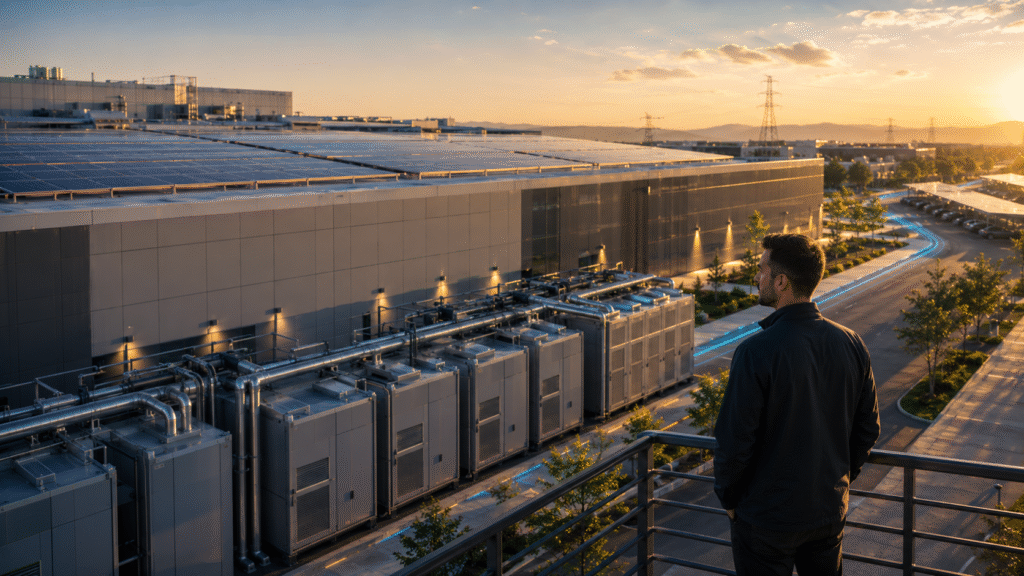
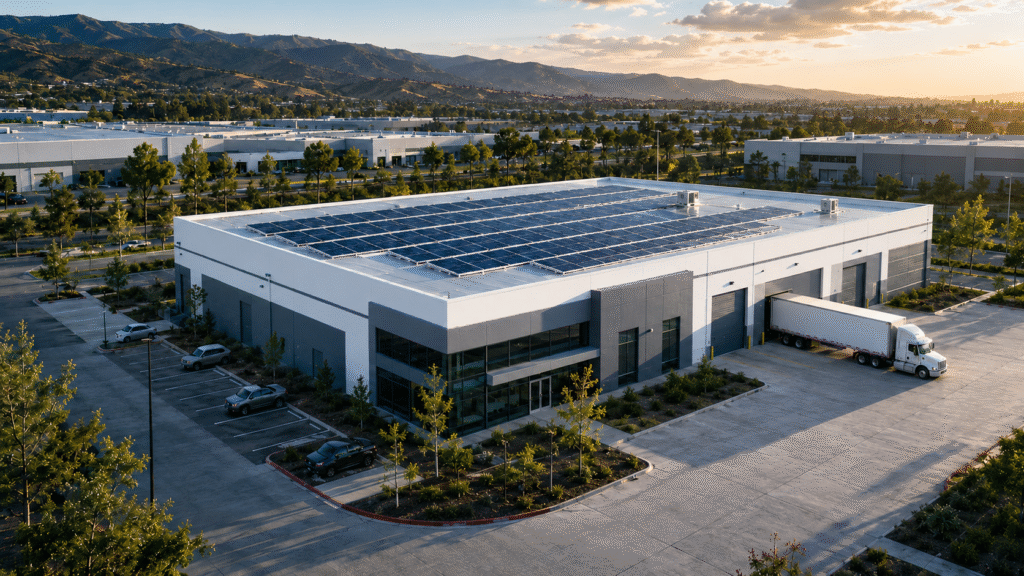
Your roof may be one of the most underused assets in your business.
Warehouses and distribution centers are built for movement.
Products move in.
Inventory moves out.
Trucks load and unload.
Teams manage logistics, storage, refrigeration, lighting, equipment, and delivery schedules.
But above all that activity, there is often a huge flat roof doing almost nothing.
Commercial solar can change that.
For warehouses and distribution centers, solar is not just about sustainability.
It is about turning unused roof space into a long-term energy asset.
A large roof can help produce power.
Battery storage can help manage demand.
EV charging can support future fleet needs.
And the building itself can become part of a smarter energy strategy.
That is the opportunity.
Why Warehouses Are Strong Candidates for Solar
Warehouses and distribution centers often have several qualities that make them good candidates for commercial solar.
They may have:
- large flat roofs
- open roof space
- strong daytime energy use
- high lighting loads
- HVAC needs
- refrigeration or cold storage loads
- equipment and machinery
- loading dock operations
- long-term property use
- high utility bills
- EV fleet or charging plans
- demand charges
- interest in lowering operating costs
Not every warehouse is a perfect fit.
But when the building, bill, roof, and business goals line up, solar can make a lot of sense.
The Big Idea: Turn Roof Space Into Productive Space
A warehouse roof usually does not generate revenue.
It protects the building.
That matters.
But with solar, the roof can do more.
It can help produce electricity for:
- lighting
- HVAC
- office areas
- equipment
- refrigeration
- security systems
- charging stations
- warehouse automation
- loading dock operations
That changes the role of the building.
The roof is no longer just overhead.
It becomes part of the energy plan.
Warehouse Energy Costs Are More Than Just Lights
Many people think warehouses are simple energy users.
Big building.
Lots of lights.
Basic utility bill.
But modern warehouses can use serious electricity.
Energy demand may come from:
- LED or high-bay lighting
- HVAC systems
- ventilation
- refrigeration
- cold storage
- conveyors
- forklifts
- loading equipment
- battery charging
- office spaces
- security systems
- dock doors
- EV chargers
- automation and robotics
The more advanced the facility, the more important energy planning becomes.
A basic warehouse may need a solar-only strategy.
A high-load logistics facility may need solar, battery storage, and EV charging planning together.
The Demand Charge Problem
For many commercial facilities, the electric bill is not just about how much electricity is used.
It may also include demand charges.
Demand charges are based on the highest level of power your building pulls from the grid during a billing period.
That matters for warehouses because demand spikes can come from:
- HVAC startup
- refrigeration cycles
- multiple chargers running
- loading dock equipment
- conveyor systems
- forklifts charging
- warehouse automation
- several systems operating at once
A warehouse may have a reasonable amount of total energy use but still get hit by expensive peaks.
That is why the solar conversation needs to include the load profile.
Not just the roof size.
Solar-Only for Warehouses
A solar-only system can be a strong fit when the warehouse uses a lot of power during the day.
Solar can help offset daytime electricity use from:
- lighting
- HVAC
- warehouse operations
- office areas
- equipment
- refrigeration
- charging systems
This can reduce how much electricity the building buys from the utility during solar production hours.
For many warehouses, this is the simplest and cleanest first step.
Solar-only may work well when:
- the business operates mostly during daylight hours
- the roof has strong usable space
- electricity usage is steady during the day
- demand charges are not the biggest issue
- backup power is not the main priority
- the financial case works without storage
Sabio takeaway
Solar-only is often the simplest path when daytime energy use is strong and predictable.
Solar + Battery for Warehouses
Battery storage becomes more important when the warehouse needs more control.
A commercial battery may help with:
- demand charge management
- peak shaving
- load shifting
- backup support
- EV charging support
- refrigeration resilience
- reducing grid dependence during expensive periods
This can be especially useful for warehouses with sudden power spikes or expensive peak demand.
Solar produces the energy.
Battery storage helps control when that energy is used.
That difference matters.
Battery storage may be worth exploring when:
- demand charges are high
- the facility has power spikes
- refrigeration is important
- EV charging is planned
- outage risk is costly
- utility rates are higher during peak periods
- the business needs more energy control
Sabio takeaway
A battery is not just an add-on.
For the right warehouse, it can become the control layer.
Cold Storage and Refrigerated Warehouses
Cold storage facilities are a different category.
They often have high, continuous energy needs.
Refrigeration does not simply turn off when the sun goes down.
That means cold storage projects need careful design.
Important questions include:
- How much power does refrigeration use?
- When do demand peaks happen?
- What happens during an outage?
- How much backup is needed?
- Can battery storage protect critical loads?
- Are there demand charges?
- Is the facility expanding?
- Are there temperature-sensitive products?
For cold storage, solar may reduce energy costs, but storage and backup planning may be just as important.
Sabio takeaway
Cold storage solar is not just about savings.
It is about protecting operations.
Warehouses and EV Fleet Charging
This is becoming a major issue.
Many warehouses and logistics facilities are preparing for electric vehicles, delivery vans, forklifts, trucks, or charging infrastructure.
EV charging can change the building’s energy profile quickly.
A facility that looked manageable before may suddenly have new demand spikes.
That is why EV charging should not be added as an afterthought.
Before adding chargers, a warehouse should consider:
- how many vehicles will charge
- when they will charge
- how fast they need to charge
- whether charging will create demand spikes
- whether solar can offset some charging load
- whether batteries can reduce peak demand
- whether electrical upgrades are needed
- whether the system should be phased
Sabio takeaway
Fleet charging is not just a parking lot upgrade.
It is an energy strategy.
Solar Carports for Warehouses and Distribution Centers
Not every warehouse has enough usable roof space.
Sometimes the parking lot is the opportunity.
Solar carports can help turn parking areas into energy-producing structures.
They may also provide:
- shaded parking
- EV charging support
- customer or employee amenity value
- additional solar capacity
- better use of open paved space
Carports are usually more expensive than simple rooftop solar, but they may make sense when roof space is limited or EV charging is part of the plan.
Sabio takeaway
The roof is not always the only energy asset.
Parking lots can matter too.
What Makes a Warehouse Solar Project Strong?
A strong warehouse solar project usually has:
- a large usable roof
- good sun exposure
- strong daytime usage
- clear ownership or roof rights
- roof condition that supports long-term solar
- structural capacity
- manageable shading
- utility bills that justify the project
- demand charge analysis
- clear financing strategy
- room for future EV charging
- a long-term building plan
The best projects are not based on guesswork.
They are based on the building, the bill, and the business plan.
What Can Make a Warehouse Project Difficult?
Warehouse solar may be harder if:
- the roof is old or weak
- the roof is crowded with equipment
- there is heavy shading
- the business leases without roof rights
- utility rules are unfavorable
- demand spikes happen outside solar production hours
- electrical upgrades are needed
- the business may relocate soon
- financing does not fit
- the project ignores EV charging growth
None of these issues automatically kills the project.
But they need to be understood early.
The worst solar project is the one that discovers major problems after the proposal is signed.
How Much Solar Does a Warehouse Need?
There is no universal answer.
The right system size depends on:
- annual electricity usage
- daytime load
- peak demand
- roof space
- utility rate structure
- demand charges
- battery needs
- EV charging plans
- refrigeration loads
- export rules
- financing structure
- long-term business goals
Some warehouses may benefit from a large rooftop system.
Others may need a smaller solar system with storage.
Some may start with solar now and add EV charging or batteries later.
The goal is not to cover every inch of the roof.
The goal is to build the strongest business case.
The Financial Case
Warehouse solar may help businesses:
- reduce monthly utility costs
- improve long-term energy predictability
- reduce exposure to rate increases
- manage demand charges with storage
- support EV fleet charging
- improve property value perception
- support sustainability goals
- use idle roof space more productively
But the financial case depends on the details.
A serious proposal should show:
- system size
- expected production
- utility savings
- demand charge impact
- storage value if included
- financing options
- incentives and tax assumptions
- maintenance responsibility
- project timeline
- payback estimate
- long-term ownership value
A savings number without assumptions is not enough.
The Emotional Side for Warehouse Owners
Warehouse owners and operators do not just want solar panels.
They want fewer surprises.
They want to protect margins.
They want to use their building smarter.
They want to prepare for rising energy demand.
They want to know they are not sitting on a roof that could be working harder for the business.
That is the emotional hook.
Solar turns unused space into control.
And control is valuable.
The Sabio Way to Evaluate Warehouse Solar
Sabio starts with the business case.
1. Review the utility bill
We look at usage, demand charges, rate structure, and seasonal patterns.
2. Study the building
We evaluate roof condition, structure, usable space, shading, and electrical access.
3. Understand operations
We look at hours, equipment, refrigeration, fleet needs, loading activity, and future growth.
4. Compare system options
Solar-only, solar + battery, EV charging, carports, or phased energy strategy.
5. Build around the financial goal
Lower bills, demand charge control, backup, property value, ESG, or fleet electrification.
The right warehouse solar project is not generic.
It is built around how the facility actually works.
Simple Example
Imagine two warehouses with the same roof size.
Warehouse A
- daytime operations
- steady lighting and HVAC use
- low demand spikes
- no EV charging plans
Solar-only may be a strong fit.
Warehouse B
- refrigerated storage
- multiple chargers
- high demand charges
- backup concerns
- 24/7 operations
Solar-only may help, but solar + battery may create a stronger strategy.
Same roof.
Different business.
Different system.
That is why the evaluation matters.
So, Is Solar Worth It for Warehouses and Distribution Centers?
Here is the clean answer:
Solar may be a strong fit for warehouses and distribution centers when the facility has usable roof or parking space, meaningful electricity usage, clear ownership rights, and a business case built around real utility data.
For some warehouses, solar-only is enough.
For others, solar + battery + EV charging planning may be the smarter move.
The right answer depends on how the facility uses power.
Not just how big the roof is.
Sabio Takeaway
A warehouse roof can be more than protection.
It can become production.
It can help lower costs.
It can support fleet charging.
It can reduce energy risk.
It can turn unused space into a business asset.
That is smarter business energy.
Ready to See What Your Warehouse Roof Could Do?
We’ll help you review your utility bills, facility profile, energy usage, and goals — then show you whether solar, battery storage, EV charging, or a phased commercial energy strategy makes sense.