
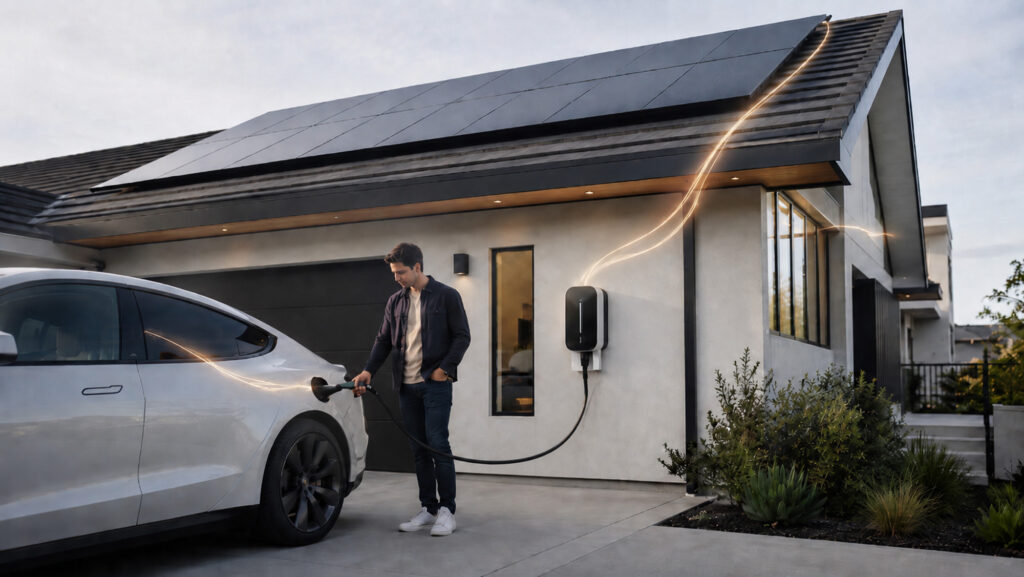
The honest answer: an EV changes your electric bill. Solar helps you take control of what happens next.
Buying an electric vehicle feels exciting.
No gas station.
Lower maintenance.
Quiet ride.
Instant torque.
A car that feels like the future.
Then the first electric bill arrives.
And reality hits.
You did not eliminate energy costs.
You moved them from the pump to your home.
That does not mean an EV is a bad decision. It means your home energy strategy matters more.
In 2026, solar and EV charging are becoming part of the same conversation.
Because if your car is going electric, your home has to get smarter too.
Why EV Charging Changes Your Home Energy Use
An electric vehicle can become one of the biggest energy loads in your home.
Think about it.
Your fridge runs all day, but it uses relatively little power.
Your lights barely move the needle.
Your laptop is nothing.
But your EV?
That is a large battery on wheels.
Charging it at home can add hundreds of kilowatt-hours to your monthly usage, depending on how much you drive.
That means your old electric bill may not represent your future.
If you are planning to buy an EV, your solar system should account for that before it is designed.
Level 1 vs. Level 2 Charging
Most homeowners have two realistic home charging options.
Level 1 charging
Level 1 uses a standard 120-volt household outlet. The Department of Energy says Level 1 charging provides about 5 miles of range per hour and can require roughly 30 hours for a full charge.
This can work if you drive very little.
But for many homeowners, it feels slow.
Level 2 charging
Level 2 charging uses 240 volts, similar to a dryer or oven circuit. The Alternative Fuels Data Center says EV owners may install Level 2 charging equipment at home for faster charging.
Level 2 is what most regular EV drivers want because it makes home charging feel normal.
Plug in at night.
Wake up ready.
That is the lifestyle shift.
Why Solar and EV Charging Fit Together
Solar makes electricity during the day.
Your EV needs electricity.
The connection is obvious.
But the strategy depends on timing.
If you work from home or your car is parked during the day, solar can help charge the EV directly while the sun is producing.
If you drive during the day and charge at night, solar still helps — but a battery, time-of-use plan, or smart charging schedule may matter more.
The key is not just:
Do I have solar?
The better question is:
When does my home use power, and when does my EV charge?
That is where smart design begins.
The Risk: Your EV Can Make Your Bill Spike
Many homeowners underestimate this.
They assume:
“I’m saving on gas, so I’m good.”
Maybe.
But if you charge at expensive peak hours, your utility bill can rise quickly.
In areas with time-of-use pricing, charging at the wrong time may cost much more than expected.
That does not mean EV charging is bad.
It means unmanaged EV charging is bad.
Smart charging lets you:
- charge during cheaper hours
- avoid peak pricing
- coordinate with solar production
- reduce grid dependence
- plan for future energy use
This is where solar, batteries, and smart chargers work together.
Does Solar Mean Free EV Charging?
Not exactly.
That phrase sounds good, but it is too simplistic.
Solar can help offset the electricity your EV uses. But whether your EV is truly powered by your own solar depends on:
- system size
- driving habits
- charging schedule
- battery storage
- utility rate plan
- net metering or buyback rules
- whether the car is home during solar production hours
So instead of saying “free charging,” the more honest idea is:
solar can reduce the cost of charging your EV and protect you from rising electricity rates.
That is still powerful.
It is just more accurate.
Should You Size Solar for Your EV?
If you already own an EV, yes — your current charging usage should be part of the solar design.
If you plan to buy an EV soon, that future load should be considered.
A solar system designed only around your current bill may be too small once you start charging at home.
Before sizing a system, ask:
- How many miles do I drive per week?
- Will I charge mostly at home?
- Will I charge during the day or at night?
- Do I have time-of-use rates?
- Do I need Level 2 charging?
- Will I add a second EV later?
- Do I want battery backup too?
Your car is not separate from your home anymore.
It is part of the home energy system.
The 2026 EV Charger Tax Credit
There is also a time-sensitive incentive to know.
The IRS says that for EV charging property bought and placed in service at your main home from January 1, 2023 through June 30, 2026, the credit equals 30% of the cost, up to a maximum credit of $1,000 per item.
The Alternative Fuels Data Center also notes that the credit for alternative fuel infrastructure is available for property placed in service by June 30, 2026.
This does not mean everyone qualifies automatically. Eligibility can depend on location and other rules, so homeowners should confirm before making decisions.
But if you are considering a home EV charger in 2026, timing matters.
What About ENERGY STAR EV Chargers?
ENERGY STAR-certified EV chargers are designed to save energy when the charger is not actively charging. ENERGY STAR says certified EV chargers help save energy and money when not in use.
That sounds small.
But smart energy is about reducing waste everywhere.
A charger that sits idle inefficiently is still part of your bill.
Solar + Battery + EV: The Smarter Home Stack
The strongest setup for many future-ready homes is:
Solar panels + battery storage + smart EV charger
Each piece has a job.
Solar panels
Produce power.
Battery storage
Stores power and improves control.
Smart EV charger
Manages when and how the car charges.
Together, they create a smarter home energy system.
Not because it sounds futuristic.
Because it solves real problems:
- rising bills
- peak pricing
- outage concerns
- EV charging costs
- dependence on the grid
That is the point.
When Solar + EV Charging Makes the Most Sense
Solar + EV charging may be a strong fit if:
- you drive regularly
- you charge mostly at home
- your electric bill is already high
- you have or plan to install Level 2 charging
- your utility uses time-of-use pricing
- your roof gets strong sun
- you want long-term energy control
- you are considering battery storage
It may be less urgent if:
- you rarely charge at home
- you drive very little
- your electricity rate is very low
- your roof has poor solar potential
- you plan to move soon
Again, the answer is not automatic.
It depends on your real life.
Questions to Ask Before Installing Solar for EV Charging
Before designing solar around an EV, ask:
- How much will my EV add to my monthly kWh usage?
- What time of day will I charge?
- Should I install Level 2 charging?
- Does my electrical panel need an upgrade?
- Will solar offset my EV charging load?
- Would a battery help?
- Does my utility offer EV time-of-use rates?
- Is there a charger incentive still available?
- Am I planning for one EV or two?
If the solar design ignores your EV, it is not complete.
The Emotional Side of Solar + EV Charging
An EV is supposed to feel freeing.
But it can create a new kind of anxiety:
“Am I charging at the wrong time?”
“Will my bill jump?”
“Do I need an electrical upgrade?”
“Will my home keep up with my life?”
That is why the best EV charging setup is not just fast.
It is calm.
You plug in.
The system handles the timing.
Your home works in the background.
That is what smarter energy should feel like.
Sabio Takeaway
An EV changes your relationship with your home.
Your car no longer just lives in the garage.
It becomes part of your energy system.
Solar helps power that shift.
Battery storage helps control it.
Smart charging helps optimize it.
In 2026, the smartest homes are not just using less energy.
They are managing energy better.
Ready to See If Solar Can Support Your EV?
We’ll help you review your electric bill, estimate your EV charging load, and see whether solar, battery storage, or a smart charger makes sense for your home.