The honest answer: a good solar installation process should feel organized, predictable, and clear.
Most homeowners do not fear solar panels.
They fear the process.
Will workers be all over the house?
Will the roof be damaged?
Will permits take forever?
Will the power be shut off?
Will the system actually work when it is done?
Those questions are normal.
Solar is not a small purchase. It is a real upgrade to your home.
So the process should not feel mysterious.
It should feel like a clear sequence, with the right people handling the right steps.
Step 1: Your Electric Bill Review
The process starts with your bill.
Not your roof.
Not a random panel count.
Your bill.
A real solar design begins by understanding how your home uses energy:
- how many kilowatt-hours you use
- when your usage is highest
- how much you pay per kWh
- whether you have time-of-use rates
- whether battery storage could help
- whether future usage may increase
This is where the real math starts.
Your bill tells the story.
The solar system should be designed around that story.
Step 2: Home and Roof Assessment
Next comes the home review.
This is where the installer checks whether your roof is actually a good candidate for solar.
They may look at:
- roof age
- roof material
- roof angle
- roof direction
- shading
- usable roof space
- vents and obstructions
- electrical panel condition
- where equipment could be installed
The U.S. Department of Energy says rooftop suitability depends on factors such as roof age, tree cover, size, shape, slope, and shading. It also notes that qualified installers design systems to meet local building, fire, and electrical codes.
This step matters because a good installer does not just ask:
“Can we fit panels here?”
They ask:
“Can we design a system that works well here?”
That is the difference between installation and strategy.
Step 3: System Design
Once your bill and roof are reviewed, the installer designs the system.
This usually includes:
- panel layout
- inverter selection
- battery option if needed
- estimated production
- expected bill offset
- roof attachment plan
- electrical design
- monitoring setup
This is where you should ask questions.
Not after everything is signed.
Ask:
- Why this system size?
- What percentage of my usage does it offset?
- What assumptions are used?
- Is battery storage included?
- What does the system back up?
- What happens if I add an EV later?
- What utility rules affect the design?
A good design should make you feel calmer.
Not more confused.
Step 4: Permits and Utility Paperwork
Before solar goes on your roof, the project usually needs approval.
That may include local building permits, electrical permits, utility interconnection paperwork, and sometimes HOA documentation.
Permitting is one of the least exciting parts of solar.
But it is important.
It helps confirm that the system meets local construction, electrical, fire, and safety requirements.
New York’s Department of Buildings, for example, notes that solar installations requiring permits also require inspections.
Rules vary by city, county, utility, and state, which is why timelines can vary.
In a good process, your installer handles most of the paperwork and keeps you updated.
The homeowner should not feel like they are chasing the system.
Step 5: Installation Day
This is the part most homeowners imagine.
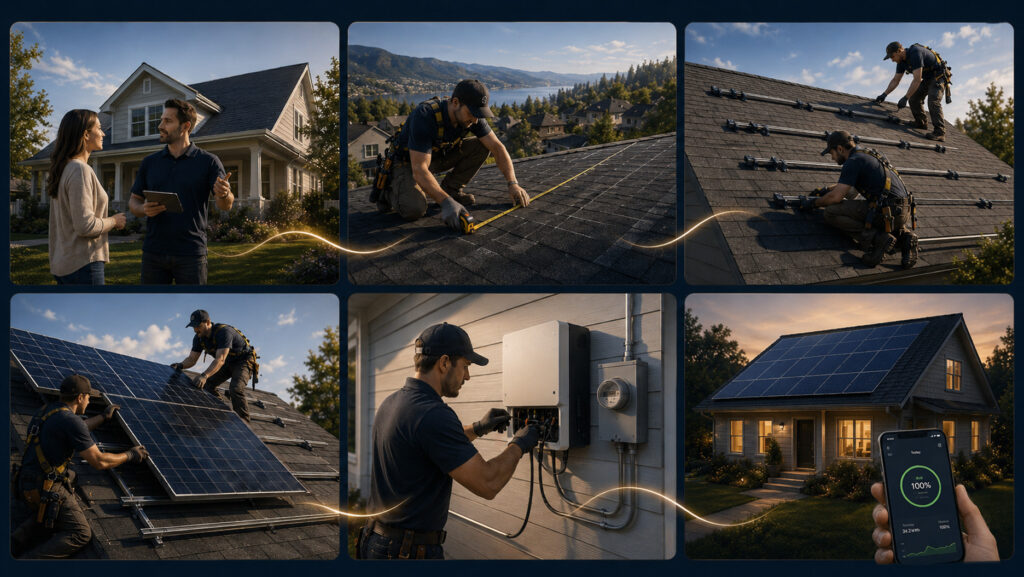
A crew arrives. Equipment is delivered. Panels are mounted. Wiring is completed. The inverter and other equipment are installed.
For many residential projects, the physical installation may take one to a few days, depending on system size, roof complexity, battery storage, and electrical work.
During installation, the crew may:
- mark roof attachment points
- install racking
- mount panels
- run electrical conduit
- install inverter equipment
- install battery equipment if included
- connect monitoring equipment
- clean the work area
Your power may need to be shut off temporarily during certain electrical work, but a good installer should explain this ahead of time.
No surprises.
That is the standard.
Step 6: Inspection
After installation, the system usually needs to be inspected before it is officially turned on.
The inspection may involve:
- electrical safety review
- roof attachment review
- labeling review
- inverter and disconnect checks
- code compliance
- battery installation review if applicable
The Department of Energy explains that solar systems undergo inspection from a certified electrician as part of the installation process.
This step is not just bureaucracy.
It protects your home.
A solar system should look good, perform well, and meet safety standards.
Step 7: Utility Approval and Permission to Operate
This is the step many homeowners do not know about.
Even after panels are installed, your system may not be allowed to operate until the utility gives final approval.
This is often called Permission to Operate, or PTO.
The utility needs to confirm the system is approved for interconnection with the grid.
This timeline can vary.
Some utilities move quickly. Others take longer.
This is one reason a finished installation may sit idle for a short period before it starts producing power.
Annoying? Sometimes.
Normal? Yes.
A good installer should explain this before installation, not after.
Step 8: System Activation and Monitoring
Once the utility approves the system, it can be turned on.
This is the moment homeowners usually get excited.
Your system begins producing energy.
Your monitoring app starts showing production.
You can see what your roof is doing in real time.
Depending on your setup, monitoring may show:
- solar production
- home consumption
- grid imports
- grid exports
- battery charging
- battery discharge
- backup reserve level
This is where solar becomes visible.
Not just panels on a roof.
A system you can understand.
Step 9: Learning How to Use the System
This part is underrated.
A good installer should show you how the system works after it is activated.
You should understand:
- how to read the app
- what normal production looks like
- what alerts mean
- how the battery behaves
- how backup works
- who to call if something looks wrong
- what maintenance is needed
Solar should not make your home feel complicated.
It should make it feel smarter.
Will Solar Damage My Roof?
This is one of the biggest homeowner fears.
The honest answer is:
Solar should not damage your roof when it is installed correctly by qualified professionals.
Mounting systems are designed to attach securely and seal properly. The real risk comes from poor installation, rushed work, weak roof conditions, or unqualified contractors.
That is why roof assessment, permitting, inspection, and workmanship matter.
Cheap solar can get expensive if it is installed badly.
Will My Power Go Out During Installation?
Sometimes, briefly.
Certain electrical work may require a temporary shutoff.
This should be planned and communicated.
For most homeowners, the disruption is manageable.
The bigger issue is not the temporary power interruption.
It is communication.
You should know what is happening, when it is happening, and why.
How Long Does the Whole Solar Process Take?
The installation itself may be quick.
The full process is longer because it includes design, permits, approvals, inspection, and utility permission.
The timeline can vary based on:
- city or county permitting
- utility approval
- roof complexity
- battery installation
- electrical upgrades
- inspection scheduling
- equipment availability
A simple roof with no battery may move faster.
A solar + battery system with panel upgrades or complex permitting may take longer.
The best answer is not a fake promise.
The best answer is a clear timeline with realistic expectations.
Red Flags During the Solar Process
Be careful if a company:
- rushes you before reviewing your bill
- skips roof condition questions
- avoids explaining utility rules
- promises a zero bill without details
- cannot explain battery backup clearly
- gives vague timelines
- does not discuss permits or inspections
- pressures you before showing system assumptions
- hides financing terms
A good solar process should make you feel informed.
The Emotional Side of Installation
Home upgrades can feel stressful.
Strangers on your roof.
Documents to sign.
Technical language.
Permits.
Utility approvals.
Big numbers.
That is real.
A good solar company understands that.
The job is not just to install panels.
The job is to make the process feel controlled, professional, and clear.
Because homeowners are not only buying equipment.
They are buying confidence.
Sabio Takeaway
Solar installation should not feel like a mystery.
It should feel like a well-managed project.
Your bill shows the need.
Your roof shows the possibility.
The design connects both.
The installation brings it to life.
The right process gives you more than panels.
It gives you confidence that your home is moving in the right direction.
Ready to See What Solar Would Look Like on Your Home?