The honest answer: the best financing option is the one that fits your business strategy — not just the one with the lowest monthly payment.
Commercial solar is not only an energy decision.
It is a financial decision.
And for businesses, that means the structure matters.
A solar project can be paid for in several ways:
- cash purchase
- commercial solar loan
- operating lease
- capital lease
- power purchase agreement, or PPA
- third-party ownership
- hybrid financing
Each option changes who owns the system, who gets the tax benefits, who handles maintenance, how savings show up, and what happens if the property is sold or leased.
That is why the real question is not:
“How much does commercial solar cost?”
The better question is:
“Which financing structure gives this business the strongest outcome?”
Why Financing Matters More for Commercial Solar
Residential solar is usually about lowering a household bill.
Commercial solar is more complex.
A business has to think about:
- cash flow
- debt capacity
- tax appetite
- depreciation
- operating expense vs. capital expense
- balance sheet treatment
- ownership timeline
- lease restrictions
- investor expectations
- sustainability goals
- future building value
- risk tolerance
The same solar system can look very different financially depending on how it is owned and financed.
That is why commercial solar should not be sold as one simple monthly payment.
It should be modeled like a business investment.
Option 1: Cash Purchase
Best for businesses that want ownership, maximum long-term value, and control.
A cash purchase means the business pays for the solar system upfront and owns it directly.
That can be attractive because the business keeps the long-term value of the system and may be able to use available incentives, depreciation, and energy savings.
The IRS says taxpayers with qualified facilities and energy storage technology placed in service after December 31, 2024 may claim the Clean Electricity Investment Credit, subject to eligibility and applicable rules.
Why businesses choose cash
Cash can create the cleanest ownership structure.
You own the system.
You control the asset.
You keep the energy savings.
You may capture tax benefits if eligible.
You avoid interest costs.
For businesses with strong cash reserves and long-term property control, this can be a powerful option.
The downside
Cash ties up capital.
That capital could otherwise be used for hiring, equipment, inventory, expansion, marketing, or other business needs.
So the question is not only:
“Can we pay cash?”
The question is:
“Is solar the best use of this cash?”
Sabio takeaway
Cash can maximize long-term value, but it only makes sense if it does not weaken the business’s flexibility.
Option 2: Commercial Solar Loan
Best for businesses that want ownership without paying everything upfront.
A commercial solar loan lets the business own the system while paying over time.
This can preserve cash while still allowing the business to benefit from ownership.
A loan may be secured or unsecured. It may be tied to the business, the property, the equipment, or a broader financing structure.
Why businesses choose loans
Loans can help businesses:
- preserve cash
- own the system
- potentially use tax benefits
- match payments against savings
- build a long-term asset
- avoid third-party ownership
What to watch
Before using debt, ask:
- What is the interest rate?
- What is the loan term?
- Are there origination fees?
- Is collateral required?
- Is there a prepayment penalty?
- Does the business keep tax benefits?
- How does the payment compare to expected savings?
- What happens if the property is sold?
- What happens if the business relocates?
A low payment is not enough.
The total cost of capital matters.
Sabio takeaway
A loan can be smart if the business wants ownership but prefers to keep cash available for operations.
Option 3: Commercial Solar Lease
Best for businesses that want solar benefits with lower upfront cost and less ownership responsibility.
A commercial solar lease usually means another company owns the system and the business pays to use it.
This can lower the upfront barrier and may shift maintenance responsibility to the system owner.
The tradeoff is that the business may not own the asset or directly receive the tax benefits.
Why businesses choose leases
Leases can appeal to businesses that:
- want lower upfront cost
- do not want to own the equipment
- prefer predictable payments
- want simpler maintenance responsibility
- lack tax appetite
- want solar without tying up capital
What to watch
Before signing a lease, ask:
- Who owns the system?
- Who maintains it?
- What is the monthly payment?
- Does the payment escalate?
- What is the contract length?
- What happens if the building is sold?
- What happens if the tenant leaves?
- Is there a buyout option?
- Who receives incentives?
- How are savings calculated?
Leases are not bad.
Unclear leases are bad.
Sabio takeaway
A lease can make commercial solar easier to adopt, but the contract must be clear enough for your CFO, landlord, lender, and future buyer to understand.
Option 4: Power Purchase Agreement, or PPA
Best for businesses that want to buy solar power without owning the system.
A PPA is different from a lease.
With a PPA, a third-party owner installs and owns the solar system, and your business buys the electricity it produces at an agreed rate.
Instead of paying for equipment, you pay for energy.
That rate may be lower than your utility rate, which can create savings with little or no upfront cost.
EnergySage describes solar leases and PPAs as structures where the homeowner or customer typically does not own the system, while the solar provider owns and maintains it; the same basic ownership logic often applies in commercial third-party-owned arrangements.
Why businesses choose PPAs
PPAs can be attractive when a business wants:
- low upfront cost
- predictable energy pricing
- little maintenance responsibility
- no direct system ownership
- potential savings without major capital outlay
- a third party to monetize tax benefits
What to watch
Before signing a PPA, ask:
- What price per kWh will we pay?
- Does the price escalate annually?
- How does the PPA rate compare with utility rates?
- What happens if utility rates fall?
- What happens if production is lower than expected?
- Who owns the renewable energy credits?
- What happens if we sell the building?
- Can we buy the system later?
- What happens at the end of the term?
Sabio takeaway
A PPA can be a strong tool when a business wants solar savings without ownership — but the rate, escalator, and transfer terms decide whether it is a good deal.
Option 5: Third-Party Ownership
Best for businesses that lack tax appetite or prefer solar as a service.
Third-party ownership is the broader category that includes many leases and PPAs.
In this model, another company owns the system and monetizes the available incentives, while the business receives energy savings through a lease payment or power purchase rate.
This can be useful when the business:
- cannot use tax credits efficiently
- wants little upfront cost
- prefers operating payments
- wants maintenance handled by someone else
- wants predictable long-term energy pricing
But it also means the business gives up some ownership benefits.
Sabio takeaway
Third-party ownership can make solar accessible, but it shifts long-term value away from the business. That tradeoff should be intentional.
Option 6: Hybrid Financing
Best for businesses that need flexibility.
Some projects use a hybrid structure.
For example:
- prepaid lease
- PPA with buyout option
- loan plus battery incentive
- landlord-tenant shared savings
- solar plus EV charger financing
- phased solar now, storage later
- multi-site portfolio financing
Hybrid structures can be useful when the project has multiple stakeholders or when the business wants to balance savings, ownership, tax treatment, and capital preservation.
EnergySage notes that prepaid leases and PPAs are becoming more popular in a post-residential-tax-credit environment because they combine some upfront payment with third-party-owned tax-credit economics and possible ownership later.
Sabio takeaway
Hybrid financing can be powerful, but it must be explained clearly. Complexity is only useful when it creates value.
The Tax Credit and Incentive Layer
Commercial solar financing is heavily affected by incentives.
The IRS Clean Electricity Investment Credit is available for qualified facilities and energy storage technology placed in service after December 31, 2024, with a base amount and potential increases depending on eligibility.
DSIRE is also a key resource because it tracks renewable energy and efficiency incentives across federal, state, local, and utility programs.
Commercial solar incentives may involve:
- federal investment tax credits
- energy storage credits
- domestic content bonuses
- energy community bonuses
- low-income or community-related bonuses
- state incentives
- utility rebates
- sales tax exemptions
- property tax treatment
- depreciation
- credit transferability
- elective pay for certain entities
This is where tax professionals matter.
Solar companies can explain the project.
Tax advisors should confirm how the business can actually use the incentives.
MACRS Depreciation
Commercial solar may also involve depreciation.
Many businesses evaluate solar through MACRS, the Modified Accelerated Cost Recovery System.
This can allow eligible businesses to recover the cost of qualifying solar equipment over an accelerated depreciation schedule, depending on tax rules and project structure.
Industry tax summaries commonly note that commercial solar entities may be able to use both the federal investment credit and MACRS depreciation, though the depreciable basis is generally reduced when the investment credit is claimed.
This is important because depreciation can improve the commercial business case.
But it also depends on the business’s tax position.
Sabio takeaway
Depreciation can make solar more attractive, but only if your business can use it. Do not assume — model it.
Operating Expense vs. Capital Expense
This is one of the most important business questions.
A cash purchase or loan may treat solar more like a capital investment.
A lease or PPA may feel more like an operating expense.
That distinction can matter for:
- accounting
- budgeting
- tax planning
- internal approvals
- debt ratios
- property ownership
- investor reporting
- tenant agreements
For some businesses, owning the asset is the priority.
For others, preserving capital and keeping payments predictable matters more.
Neither is automatically better.
The right structure depends on business goals.
Landlord-Tenant Solar Financing
Commercial solar gets more complicated when the building owner and energy user are not the same.
Common scenarios:
- landlord owns the roof, tenant pays the utility bill
- tenant wants savings but cannot modify the roof
- landlord wants property value, tenant wants lower bills
- multi-tenant building has shared meters
- tenants have separate utility accounts
- landlord wants solar as an amenity
- tenant wants EV charging
This can be solved, but it requires structure.
Possible approaches include:
- landlord-owned solar
- tenant lease addendum
- shared savings agreement
- PPA
- roof license agreement
- green lease terms
- multi-tenant allocation model
Sabio takeaway
If the roof owner and bill payer are different, the financing has to align incentives before the system is designed.
The Emotional Side of Commercial Solar Financing
Business owners do not just worry about price.
They worry about regret.
They ask:
“Are we locking into the wrong structure?”
“Will this hurt cash flow?”
“Will this look smart to investors?”
“Will we still own the value later?”
“What happens if we sell the building?”
“Are the savings real?”
That is why commercial solar financing needs clarity.
A good financing discussion should make the business feel more in control.
Not more confused.
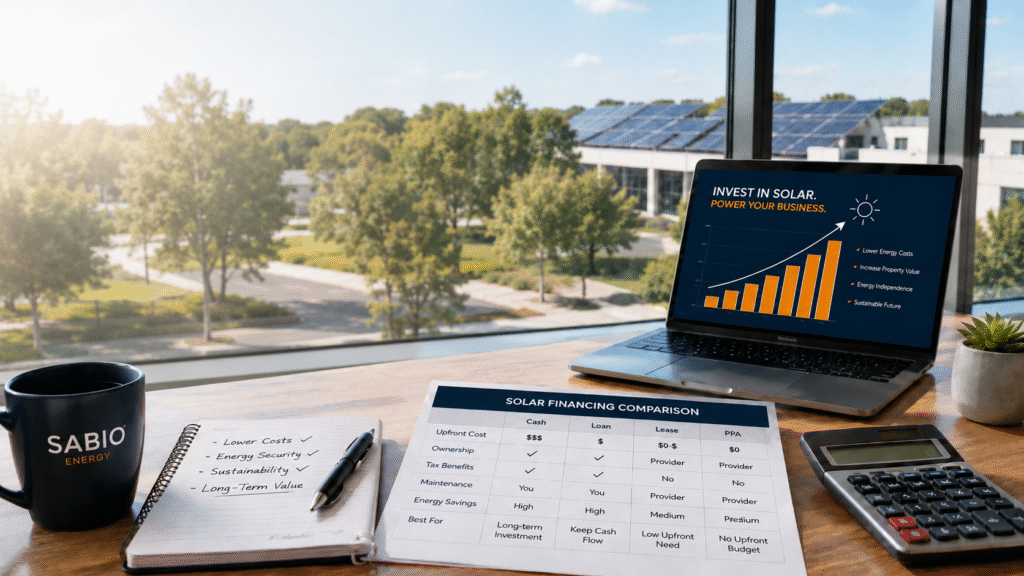
Simple Comparison
Cash Purchase
Best for maximum ownership and long-term value.
Solar Loan
Best for ownership while preserving cash.
Lease
Best for lower upfront cost and less ownership responsibility.
PPA
Best for buying solar power without owning the system.
Third-Party Ownership
Best when the business lacks tax appetite or wants solar as a service.
Hybrid Structure
Best when the project needs flexibility around ownership, tax value, or future buyout.
Questions to Ask Before Choosing Commercial Solar Financing
Before selecting a financing option, ask:
- Who owns the system?
- Who receives the tax benefits?
- Who maintains the system?
- What is the upfront cost?
- What is the monthly payment?
- Does the payment escalate?
- What is the contract term?
- What is the total cost over the full term?
- What happens if we sell the property?
- What happens if a tenant leaves?
- Can we buy out the system?
- Who owns the renewable energy credits?
- What assumptions are used for savings?
- How does the financing affect our balance sheet?
- Can our business actually use the tax benefits?
If the answers are unclear, the proposal is not ready.
Red Flags in Commercial Solar Financing
Watch for:
- vague ownership terms
- unclear tax credit assumptions
- hidden escalators
- savings estimates that ignore demand charges
- PPA rates that do not compare clearly with utility rates
- lease terms that are hard to transfer
- no explanation of depreciation
- no plan for roof sale or tenant changes
- no maintenance responsibility spelled out
- one-size-fits-all financing
Commercial solar financing should not feel like a trap.
It should feel like a strategy.
So Which Financing Option Is Best?
Here is the clean answer:
Cash is strongest for businesses that want maximum long-term ownership value.
Loans are useful when a business wants ownership but wants to preserve cash.
Leases and PPAs can work when low upfront cost, tax monetization, and maintenance simplicity matter more than ownership.
Hybrid structures can be smart when the project has multiple stakeholders or future buyout goals.
There is no universal best option.
There is only the best fit for the business case.
Sabio Takeaway
Commercial solar financing is not just about paying for panels.
It is about deciding who owns the value.
The energy savings.
The tax benefits.
The depreciation.
The long-term asset.
The contract obligations.
The operational control.
The right financing structure should make the project clearer, not more complicated.
That is smarter business energy.
Ready to Compare Commercial Solar Financing Options?