The honest answer: a good commercial solar installation should feel planned, professional, and controlled — not disruptive.
Most business owners do not fear solar panels.
They fear the process.
Will construction interrupt operations?
Will the roof be damaged?
Will employees or customers be affected?
Will permits delay the project?
Will the utility take forever?
Will the system actually perform after it is installed?
Those are the right questions.
Commercial solar is not just an energy upgrade.
It is a construction, electrical, financial, and operational project.
That means the process needs to be clear before the first panel ever reaches the roof.
Commercial Solar Is More Complex Than Residential Solar
Residential solar usually involves one home, one roof, one electric bill, and one homeowner decision.
Commercial solar can involve:
- building owners
- business operators
- tenants
- facility managers
- finance teams
- tax advisors
- roofers
- engineers
- utilities
- permitting departments
- insurance carriers
- lenders
- property managers
That does not mean the process has to feel chaotic.
It means the process needs structure.
A good commercial solar project is not rushed.
It is sequenced.
Step 1: Business Energy Review
The first step is not the roof.
It is the utility bill.
A commercial solar project should begin by reviewing:
- 12 months of utility bills
- kWh usage
- peak demand
- demand charges
- rate structure
- time-of-use periods
- seasonal changes
- operating schedule
- planned growth
- EV charging needs
- backup or resilience goals
This matters because commercial buildings are billed differently than homes.
For many businesses, demand charges can be a major part of the bill. NREL notes that demand charges are commonly assessed monthly based on the customer’s peak demand during that month.
The goal is simple:
Understand what the business is actually paying for before designing anything.
Step 2: Site and Roof Assessment
Once the energy profile is understood, the site needs to be evaluated.
This may include:
- roof condition
- roof age
- roof membrane type
- structural capacity
- available roof area
- shading
- HVAC units
- drains
- vents
- skylights
- parapets
- fire access pathways
- equipment location
- electrical room access
- carport or land opportunities
The Department of Energy says rooftop solar potential depends on factors like roof size, shading, direction, and location, and that technical potential is not the same as economic potential.
That distinction matters.
A commercial roof may look large, but not all roof space is usable.
A good site assessment separates what looks possible from what is actually practical.
Step 3: Engineering and System Design
After the site review, the project moves into design.
This is where the solar concept becomes a real system.
The design may include:
- panel layout
- racking method
- inverter selection
- battery storage option
- electrical design
- single-line diagram
- structural review
- production estimate
- demand charge analysis
- interconnection strategy
- monitoring plan
- equipment placement
- construction plan
This is also where solar-only vs. solar + battery should be evaluated.
A business with strong daytime usage may need a different system than a business with high demand spikes, refrigeration loads, or EV charging plans.
The right question is not:
“How many panels fit?”
The right question is:
“What system solves the business problem?”
Step 4: Proposal and Business Case Review
Before signing, the business should understand the actual case.
That includes:
- total system cost
- expected production
- projected savings
- demand charge impact
- battery value if included
- financing options
- tax assumptions
- incentive assumptions
- maintenance responsibilities
- warranties
- installation timeline
- expected disruption
- utility approval timeline
- ownership structure
This is where many bad projects go wrong.
The proposal should not just show a savings number.
It should explain the assumptions behind the savings number.
If the assumptions are unclear, the proposal is not ready.
Step 5: Permitting
Commercial solar usually requires permits before installation.
The Department of Energy explains that permitting and inspection must happen before a solar array can receive permission to interconnect to the grid and begin producing electricity. Local governments typically require installers to obtain permits before rooftop panels are installed, and an inspection follows installation to confirm safety codes are met.
Commercial permitting may involve:
- building permits
- electrical permits
- fire code review
- structural engineering documents
- zoning review
- battery storage permits if applicable
- carport or ground-mount permits
- equipment specifications
- roof plans
- site plans
This part is not exciting.
But it protects the business.
Permits make sure the system is designed to meet code, safety, and local requirements.
Step 6: Utility Interconnection
This is one of the most important steps.
A commercial solar system that connects to the grid needs utility approval.
The EPA explains that interconnection standards define how distributed generation systems, such as solar photovoltaic systems, can connect to the grid. It also notes that inconsistent or complex interconnection processes can add costs and delays, creating barriers to project development.
For commercial projects, interconnection can be more involved because the system may be larger and may affect local grid equipment.
Utility review may include:
- interconnection application
- system size review
- transformer capacity review
- export limits
- protection equipment
- metering requirements
- engineering study
- interconnection agreement
- Permission to Operate
This is why commercial solar timelines can vary.
The building may be ready.
The contractor may be ready.
But the utility still has to approve the connection.
Step 7: Procurement and Scheduling
Once design, permits, and utility steps are moving, the project team schedules equipment and installation.
This may include:
- solar panels
- inverters
- racking
- wiring
- switchgear
- monitoring equipment
- batteries if included
- EV chargers if included
- safety equipment
- cranes or lifts
- roof protection materials
Scheduling also has to account for the business itself.
A commercial project needs to consider:
- operating hours
- customer traffic
- delivery windows
- employee access
- tenant communication
- rooftop access
- parking access
- noise
- safety zones
- weather
- electrical shutdown timing
The best installation plan is not just technically correct.
It is operationally considerate.
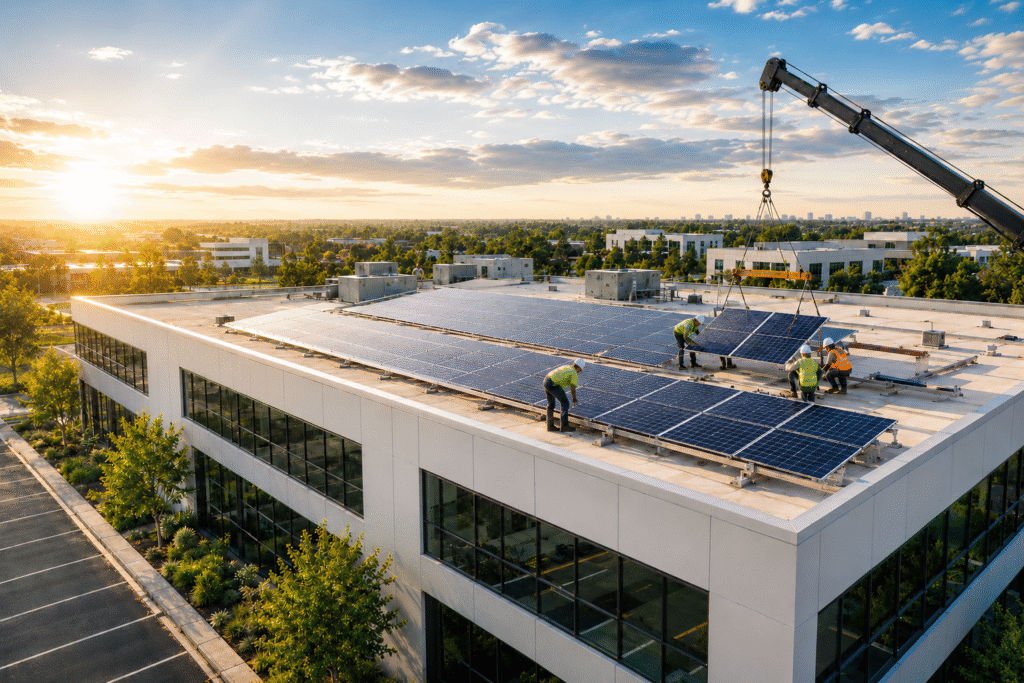
Step 8: Installation
Installation is where the project becomes visible.
Depending on the project, crews may:
- stage materials
- prepare roof access
- protect roof surfaces
- install racking
- mount panels
- run conduit
- install inverters
- install battery equipment
- connect electrical components
- configure monitoring
- label equipment
- clean up the work area
Commercial installation may take days, weeks, or longer depending on system size, roof complexity, weather, equipment availability, and electrical work.
The key is communication.
A business should know:
- who is on site
- what areas are restricted
- when noisy work happens
- whether power shutoffs are needed
- when inspections occur
- when the system is expected to activate
No surprises.
That is the standard.
Step 9: Electrical Work and Shutdown Planning
Some commercial solar projects require temporary electrical shutdowns.
This is often the part businesses worry about most.
A shutdown may be needed for:
- interconnection work
- service upgrades
- switchgear work
- inverter connection
- battery integration
- meter work
- final commissioning
The important thing is planning.
Shutdowns should be coordinated around business operations whenever possible.
For some businesses, even a short outage can affect:
- refrigeration
- point-of-sale systems
- elevators
- manufacturing equipment
- medical equipment
- servers
- security systems
- customer experience
A serious commercial installer should discuss this early.
Not the day before.
Step 10: Inspection
After installation, the system usually needs inspection.
The Department of Energy explains that following installation, a local government professional inspects the new array to ensure safety codes have been followed before the utility connects the system to the grid.
Commercial inspections may review:
- electrical work
- structural attachments
- roof penetrations
- grounding
- labeling
- disconnects
- inverter setup
- battery installation
- fire access pathways
- code compliance
- safety equipment
Inspection is not just a box to check.
It is part of protecting the building, the business, and the people inside it.
Step 11: Commissioning
Commissioning is the process of verifying that the system works as designed.
This may include:
- inverter testing
- communications testing
- monitoring setup
- battery testing
- performance verification
- safety checks
- system configuration
- utility meter coordination
- owner training
This step matters because commercial solar is not just installed.
It needs to be activated, tested, and handed over properly.
A good commissioning process makes sure the system is ready to operate.
Step 12: Permission to Operate
Even after installation and inspection, the system may still need final utility approval.
This is often called Permission to Operate, or PTO.
PTO means the utility has approved the system to operate in parallel with the grid.
This can be frustrating because the panels may be physically installed but not yet active.
That delay is normal.
The utility has to confirm that interconnection requirements are met before the system begins operating.
A good project team should explain this timeline upfront.
Step 13: Monitoring and Handoff
Once the system is active, the business should receive a clear handoff.
That may include:
- monitoring app or portal access
- system documentation
- warranty information
- maintenance schedule
- production expectations
- emergency shutdown instructions
- contact information
- performance reporting
- battery settings if included
- EV charger controls if included
Commercial solar should not feel like a mystery after it is installed.
The business should understand what the system is doing and how to track it.
Will Installation Disrupt the Business?
It can — but it should be managed.
A commercial solar installation may affect:
- parking
- roof access
- loading areas
- tenant communication
- electrical systems
- certain work zones
- customer flow
- employee movement
But a good project plan reduces disruption.
The goal is not pretending installation is invisible.
The goal is making it predictable.
Business owners can handle inconvenience.
They hate surprises.
Will Solar Damage the Roof?
Commercial solar should not damage the roof when designed and installed correctly.
But roof condition matters.
A responsible process should include:
- roof assessment
- structural review
- racking plan
- waterproofing strategy
- roof warranty review
- walkway and access planning
- coordination with roofing professionals if needed
If a roof is near replacement, fix that first.
Solar should be a long-term asset.
It should not create a roof problem.
How Long Does Commercial Solar Installation Take?
The physical installation timeline depends on system size and complexity.
But the full project timeline includes much more:
- bill review
- site assessment
- engineering
- proposal
- financing
- permits
- utility interconnection
- procurement
- installation
- inspection
- commissioning
- PTO
EPA’s on-site project development process lists “build and commission your project” as the final step after goal setting, site assessment, RFP/proposal review, and contract selection.
That is the right way to think about commercial solar.
Installation is one stage.
The project is the whole sequence.
Red Flags During a Commercial Solar Installation Process
Be careful if a company:
- gives a proposal without reviewing utility bills
- ignores demand charges
- does not assess roof condition
- skips structural questions
- cannot explain interconnection
- promises unrealistic timelines
- avoids discussing shutdowns
- does not explain battery backup limits
- has no tenant or operations plan
- gives vague warranty information
- cannot explain who handles permits
- treats commercial solar like residential solar
Commercial solar should not feel improvised.
It should feel engineered.
The Emotional Side of Commercial Installation
Business owners do not just want solar installed.
They want confidence that the project will not hurt the business while trying to help it.
They want to know:
“Will this be handled professionally?”
“Will our operations keep running?”
“Will the roof be protected?”
“Will the utility delay us?”
“Will this actually work after installation?”
Those concerns are not obstacles.
They are the job.
A good commercial solar partner does not just install equipment.
They manage uncertainty.
Sabio Takeaway
Commercial solar installation is not one event.
It is a sequence:
Bill review.
Site assessment.
Engineering.
Permits.
Utility approval.
Construction.
Inspection.
Commissioning.
Monitoring.
The right process gives your business clarity before, during, and after installation.
That is what smarter business energy should feel like.
Ready to See What Commercial Solar Would Look Like for Your Building?
We’ll help you review your utility bills, facility profile, energy usage, and goals — then show you whether solar, battery storage, EV charging, or a phased commercial energy strategy makes sense.