The honest answer: enough to match your real life — not enough to impress a salesperson.
A lot of homeowners think solar starts with the roof.
How many panels fit?
How big is the house?
How sunny is the state?
Those things matter.
But they are not the starting point.
The real starting point is your electric bill.
Because solar is not about covering your roof with panels.
It is about replacing the electricity your home actually uses.
And in 2026, that distinction matters more than ever.
Bigger Is Not Always Better
Some solar quotes are built to look impressive.
Big system.
Big savings estimate.
Big promise.
But a bigger system is not automatically a better system.
If your system is oversized, poorly designed, or mismatched to your utility rules, you may end up paying for solar production your home cannot fully use.
That is not smarter energy.
That is just more equipment.
The best residential solar system is sized around:
- your annual electricity usage
- your roof space
- your sunlight exposure
- your utility rules
- your future energy needs
- whether you plan to add battery storage
The goal is not the biggest system.
The goal is the smartest system.
Start With Your kWh Usage
Your electric bill has one number that matters more than almost anything else:
kWh used.
That stands for kilowatt-hours.
It tells you how much electricity your home actually consumes.
A homeowner using 500 kWh per month does not need the same solar system as a homeowner using 1,500 kWh per month.
Simple.
Different lifestyle.
Different appliances.
Different home.
Different solar design.
Many solar sizing methods start by using your monthly or annual kWh usage, then factoring in local sunlight and panel output. SolarReviews describes the basic formula as monthly energy usage divided by monthly peak sun hours, then divided by solar panel output.
Why Annual Usage Is Better Than One Month
Do not size your solar system from one electric bill.
One month can lie.
Maybe it was August and your AC was running nonstop.
Maybe it was January and your heating system worked harder.
Maybe you were traveling and used less energy than normal.
A better approach is to look at 12 months of usage.
That gives a clearer picture of how your home actually behaves across seasons.
Solar is a long-term system.
It should not be designed from one weird month.
Roof Size Matters — But It Comes Second
Once your usage is clear, the next question is whether your roof can support the system your home needs.
The U.S. Department of Energy says rooftop suitability depends on factors like roof age, tree cover, size, shape, slope, and shading. It also notes that solar panels often perform best on south-facing roofs with a slope between 15 and 40 degrees, though other roof types can still work.
That means two homes with the same electric bill can need different solar designs.
One may have a wide, sunny roof.
Another may have shade, vents, dormers, or limited usable space.
Solar is not just math.
It is math plus architecture.
Sunlight Is Not the Same Everywhere
A solar panel in Arizona does not produce the same amount of energy as the same panel in New Jersey.
Location matters.
Sunlight hours, weather patterns, seasonal variation, roof orientation, and shading all affect production.
That is why solar sizing should always be local.
A “standard system” is not enough.
A smart quote should model your home based on:
- state
- roof direction
- roof angle
- shade
- annual sun exposure
- utility territory
- electricity rate plan
If someone gives you a generic number too fast, slow down.
The Battery Question Changes the Size
In 2026, system size is not just about panels.
It is also about storage.
A solar-only system asks:
How much electricity can I produce during the day?
A solar + battery system asks:
How much of that power can I store and use later?
That changes the strategy.
A battery may help you:
- use more of your own solar energy
- reduce evening grid usage
- avoid peak pricing
- keep essentials running during an outage
- depend less on export credits
The Department of Energy explains that solar energy storage helps make solar electricity available when sunlight is not, including later in the day or when needed.
So when you ask, “How much solar do I need?” the better question may be:
How much solar and storage do I need to match the way my home actually uses energy?
Future Usage Matters
A good solar design should not only look at how your home uses energy today.
It should also ask what your life might look like over the next few years.
Are you planning to add:
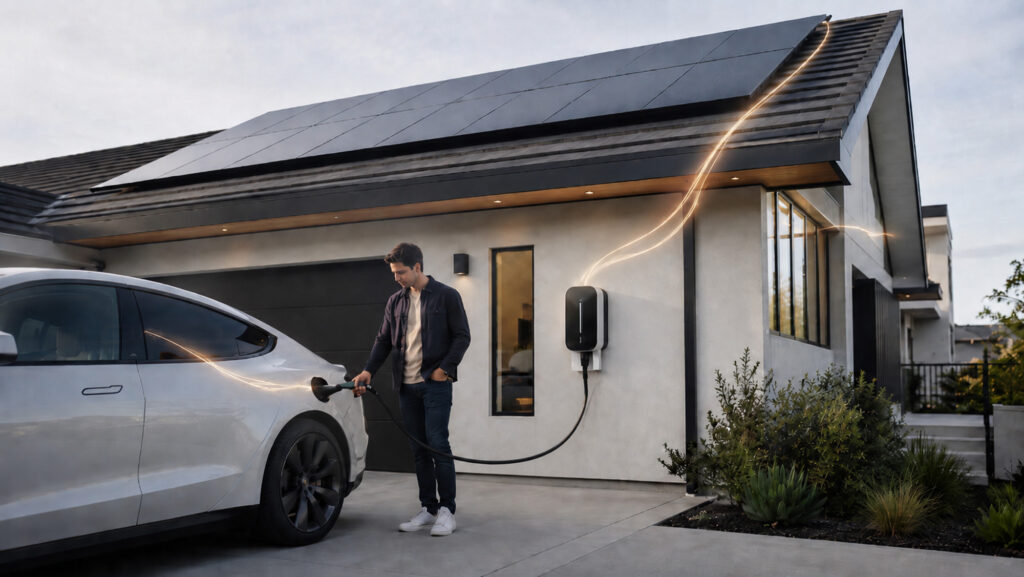
- an electric vehicle?
- a heat pump?
- a pool?
- a home office?
- a second refrigerator?
- a larger family?
- battery backup?
- smart appliances?
If yes, your future usage may be higher than your current usage.
That does not always mean you should oversize the system now.
But it does mean your design should be honest about where your home is headed.
Solar is a long-term decision.
Your future should be part of the math.
What About the 2026 Federal Tax Credit Change?
This is important.
The old federal Residential Clean Energy Credit is no longer available for residential clean energy property placed in service after December 31, 2025, according to the IRS.
That means homeowners in 2026 should be more careful about system sizing.
When a major federal incentive is no longer part of the equation, you do not want to overbuy.
You want the system that actually makes sense for your home, your usage, your utility rules, and your budget.
In 2026, precision matters more.
The Emotional Side of Sizing Solar
This is the part most solar companies skip.
Homeowners are not just asking:
“How many panels do I need?”
They are really asking:
“Can I stop feeling stressed every time my bill comes?”
“Will this make my home feel more secure?”
“Am I making a smart decision or getting sold?”
That matters.
Because solar is not just equipment.
It is a decision about your home, your money, and your sense of control.
The right system should give you confidence.
Not confusion.
Simple Example
Let’s say one home uses:
900 kWh per month
Another home uses:
1,500 kWh per month
The second home likely needs a larger solar system.
But that is not the whole story.
If the 900 kWh home has a perfect sunny roof and uses most electricity during the day, solar-only may work very well.
If the 1,500 kWh home has time-of-use rates, evening usage, and outage concerns, solar + battery may be a better strategy.
Same product category.
Different design.
Different outcome.
The Sabio Way to Size Solar
We do not start with panels.
We start with the problem.
Step 1: Understand your bill
How much power do you actually use?
Step 2: Understand your home
What can your roof realistically produce?
Step 3: Understand your utility
What does your utility charge you? What does it credit you?
Step 4: Understand your lifestyle
Do you use power mostly during the day, at night, or both?
Step 5: Understand your future
Are you adding an EV, heat pump, battery, or other electric load?
That is how you design a system that feels intelligent.
Not oversized.
Not underpowered.
Right-sized.
Questions to Ask Before Sizing Your System
Before accepting any solar quote, ask:
- How much electricity did I use over the last 12 months?
- What percentage of my usage is this system designed to offset?
- How much usable roof space do I have?
- How much shade affects the panels?
- What happens if I add an EV later?
- Does a battery change the design?
- What utility rules affect my savings?
- What assumptions are used in the production estimate?
- Is this system sized for my actual usage or just my roof capacity?
If the answer is vague, keep asking.
Clarity is the product.
So, How Much Solar Do You Actually Need?
Here is the clean answer:
You need enough solar to offset the right amount of your real electricity usage, based on your roof, utility rules, future plans, and whether storage makes sense.
Not the biggest system.
Not the cheapest system.
The right system.
That is where the savings come from.
That is where the confidence comes from.
Sabio Takeaway
Solar sizing is not about filling your roof.
It is about designing a home energy system around your life.
Your bill shows the past.
Your roof shows the potential.
Your goals show the future.
The right solar system connects all three.
Ready to Find Your Right Solar Size?
We’ll help decode your usage, your roof potential, and whether solar-only or solar + battery makes sense.