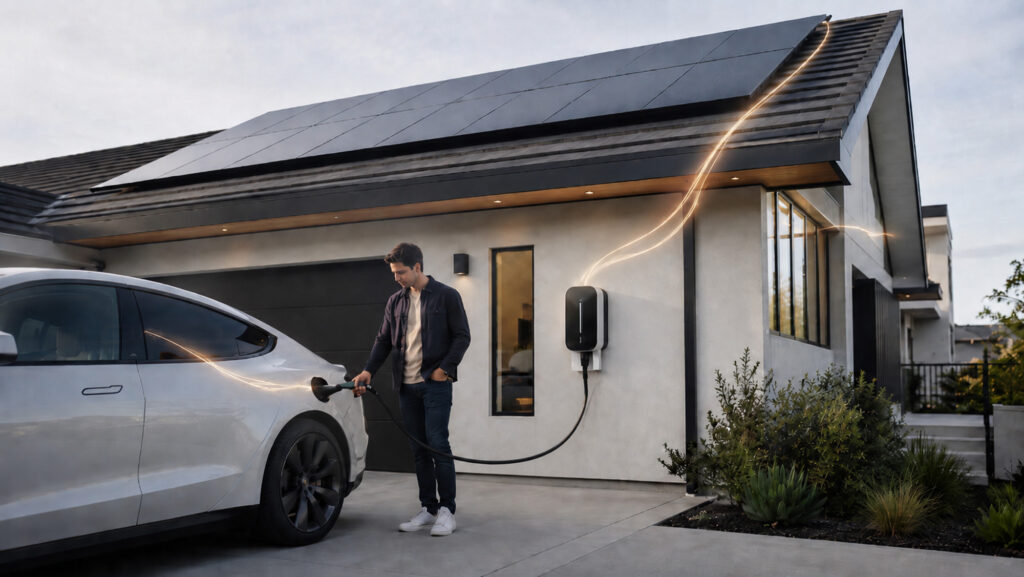

The honest answer: solar panels lower your bill. Solar + battery gives you more control.
For a long time, residential solar was mostly about one thing:
Put panels on your roof.
Make electricity during the day.
Send extra power back to the grid.
Lower your bill.
That model still matters.
But in 2026, the smarter question is no longer just:
“Should I get solar?”
It is:
“Should I get solar only — or solar with a battery?”
Because those are two different energy strategies.
One helps you produce power.
The other helps you decide when to use it.
And that difference matters more than ever.
Solar-Only: The Simple Version
A solar-only system uses panels to convert sunlight into electricity for your home.
During the day, your home uses the power your panels produce. If your system produces more than you are using at that moment, the extra power may be sent back to the grid, depending on your utility rules.
That is the classic solar model.
Solar-only can be a good fit if:
- you have strong daytime electricity usage
- your utility still gives fair credit for exported solar
- your budget is focused on lowering upfront cost
- outages are rare in your area
- you do not need backup power
- your main goal is bill reduction
Solar-only is usually simpler and less expensive than solar + battery.
That matters.
A battery can be powerful, but it is not free. If your utility rules are favorable and your home uses a lot of energy during the day, solar-only can still make sense.
Solar + Battery: The Smarter Control System
A solar + battery system does everything solar-only does — but adds storage.
Instead of sending all extra solar power back to the grid, your battery can store some of that energy so you can use it later.
At night.
During peak pricing hours.
During outages.
When the grid is expensive or unreliable.
The U.S. Department of Energy explains that storage helps solar contribute electricity when the sun is not shining by releasing energy when it is needed.
That is the real value of a battery:
It turns solar from a daytime power source into a home energy strategy.
The Difference
Solar-only can help you feel relief.
Solar + battery can help you feel prepared.
That may sound simple, but it matters.
Because homeowners are not only worried about numbers.
They are worried about:
- opening another high utility bill
- losing power during extreme weather
- not knowing how much rates will rise
- feeling stuck with the utility
- wanting their home to feel more future-ready
Solar panels address the bill.
Batteries address the feeling of dependence.
That is why storage is becoming a bigger part of the conversation.
Why Batteries Matter More in 2026
In some markets, the value of sending extra solar power back to the grid has changed.
California is the biggest example.
Newer California solar customers are generally under the Net Billing Tariff, while older NEM tariffs are closed to new enrollments. Under net billing, exported energy is valued differently than it was under older net metering structures.
Translation:
If your utility does not pay much for exported solar, it may be smarter to store more of your own power and use it later.
That is where batteries become more important.
Not because everyone needs one.
Because in certain states, utilities, and rate plans, a battery can change the math.
Solar Panels vs. Solar + Battery: The Simple Comparison
Solar Panels Only
Best for:
- lowering your electric bill
- using daytime solar power
- reducing grid electricity purchases
- keeping upfront cost lower
- homes with good export credit rules
Main limitation:
You usually do not have backup power during an outage unless your system is specifically designed with storage or backup capability.
Solar + Battery
Best for:
- storing extra solar power
- using solar at night
- reducing peak-hour electricity costs
- backup power during outages
- homes in markets with lower export credits
- homeowners who want more control
Main limitation:
Higher upfront cost and more design complexity.
The Outage Question
This is where many homeowners get confused.
Solar panels alone usually do not mean your home stays powered during an outage.
Why?
Because most grid-tied solar systems shut down during outages for safety, so they do not send power onto lines while utility crews may be working.
A battery system, when designed properly, can keep selected parts of your home running.
The Department of Energy notes that pairing solar with storage can help make solar energy available during outages.
That does not mean every battery powers your whole house automatically.
A good installer should explain:
- what loads are backed up
- how long the battery may last
- whether it supports whole-home backup
- whether it backs up essentials only
- how it behaves during extended outages
This is where honest design matters.
Do not buy a battery because someone says “backup.”
Ask:
Backup for what? For how long? Under what conditions?
When Solar-Only Makes More Sense
Solar-only may be the better choice if:
- your budget is tight
- your utility offers strong export credits
- your daytime usage is high
- outages are not a major concern
- your goal is mainly monthly bill reduction
- you want the simplest system possible
There is nothing wrong with solar-only.
A clean, well-designed solar system can still be a smart move.
The key is not letting someone sell you a battery you do not need.
When Solar + Battery Makes More Sense
Solar + battery may be a better fit if:
- your utility pays less for exported solar
- your home has time-of-use rates
- you want backup power
- your area has outages or grid instability
- you live in a high-rate state
- you want to use more of your own solar energy
- you plan to add an EV, heat pump, or more electric appliances
In places like California, battery storage can be especially important because system value increasingly depends on using your own solar power instead of exporting it at lower-value times.
In Texas, the picture is different. Some homeowners choose batteries not only for savings, but because grid reliability and buyback plan terms vary by provider. Texas solar buyback plans can differ widely in rates and rules, so the best setup depends on the homeowner’s retail electric plan and usage pattern.
What About the Federal Tax Credit?
This part is important.
The old federal Residential Clean Energy Credit is no longer available for residential clean energy property placed in service after December 31, 2025, according to the IRS.
So in 2026, homeowners should not make the decision based on the assumption that a new customer-owned residential solar or battery system automatically qualifies for the old 30% federal credit.
That does not mean solar is dead.
It means the decision has to be smarter.
The value now depends more on:
- local rates
- state incentives
- utility rules
- financing structure
- battery strategy
- system design
- long-term energy usage
The Wrong Way to Buy Solar + Battery
The wrong way is simple:
Someone shows you a big battery, a big monthly savings number, and says:
“Don’t worry. It will pay for itself.”
That is not enough.
Before buying solar + battery, ask:
- What is my current price per kWh?
- What is my daytime usage?
- What does my utility pay for exported solar?
- Do I have time-of-use pricing?
- What exactly does the battery back up?
- How many hours of backup should I realistically expect?
- What happens during multiple cloudy days?
- What is the payback difference between solar-only and solar + battery?
If the salesperson cannot answer clearly, slow down.
Your home deserves better than a generic pitch.
The Sabio Way to Think About It
Do not start with equipment.
Start with the problem.
If the problem is:
“My bill is too high.”
Solar-only may be enough.
If the problem is:
“My bill is too high and I want backup power.”
Solar + battery may make more sense.
If the problem is:
“My utility does not pay much for extra solar.”
Battery storage may help you keep more value inside the home.
If the problem is:
“I want a future-ready home.”
Solar + battery becomes part of a bigger energy strategy.
That is the key.
The system should match the real problem.
So Which One Should You Choose?
Here is the clean answer:
Choose solar-only if your main goal is lower cost and your utility rules still make solar exports valuable.
Choose solar + battery if you want more control, backup capability, and better use of your own solar power — especially in markets where export credits are weaker or peak rates are high.
Neither option is automatically better.
The right answer depends on your home.
Sabio Takeaway
Solar panels help your home produce power.
A battery helps your home control power.
That is the difference.
And in 2026, control is becoming just as important as production.
Ready to Compare Solar vs. Solar + Battery for Your Home?
Your electric bill, utility rules, and usage pattern tell the story.
We help decode it — then show you whether solar-only or solar + battery makes more sense.